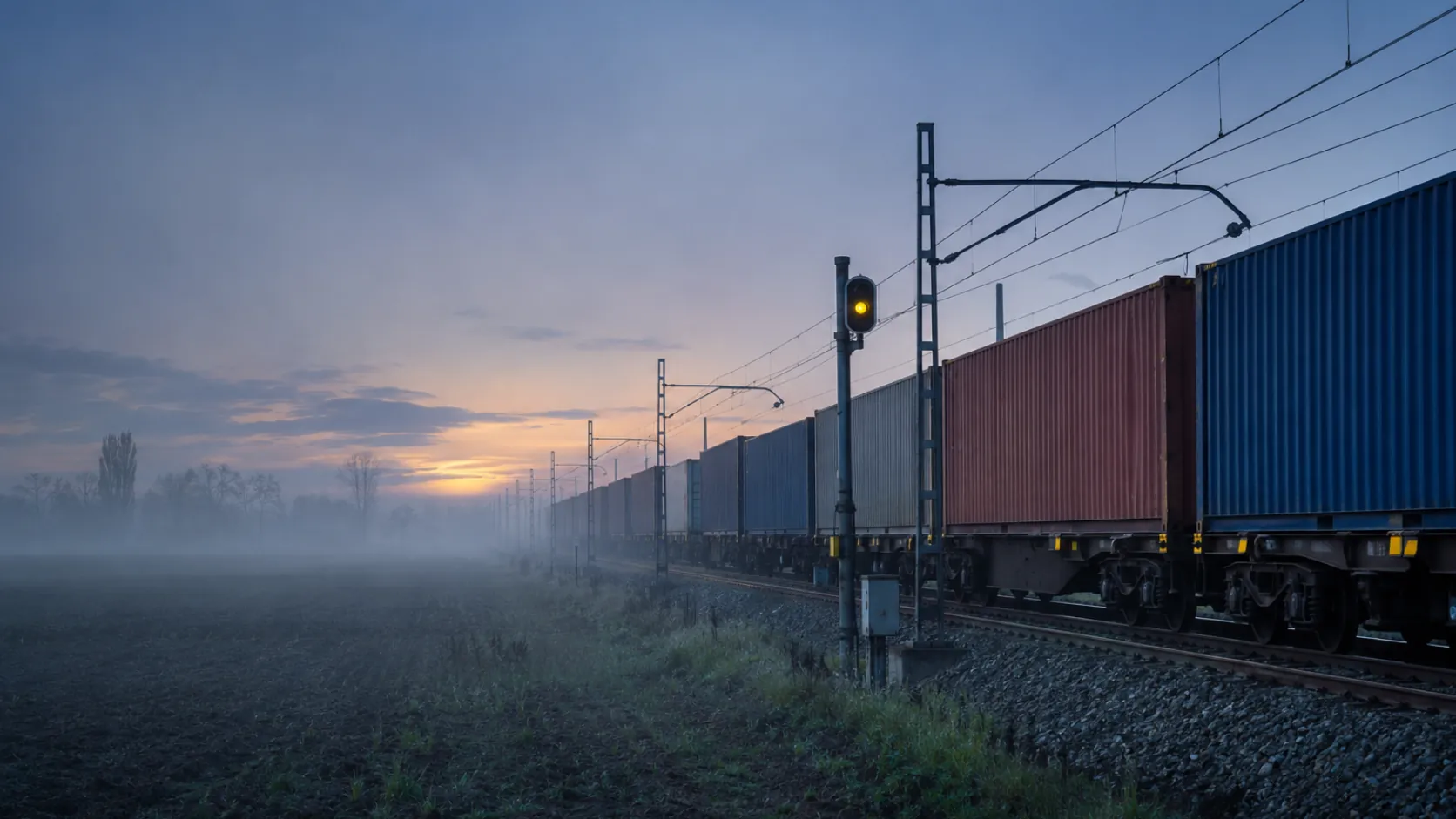
What a block train is
There are two approaches to rail freight. In the first, wagons from different customers are collected at stations or yards, joined into a train, marshalled along the way and then distributed: this is the single wagonload system, or wagon group system. In the second, the block train, the train leaves already complete and arrives intact, with no marshalling stops. The wagons stay coupled together for the whole cycle: load, travel, unload, return.
The advantage is a simple route: fewer shunting movements, fewer handovers, fewer chances of delay and damage to the goods. The limit is the commitment: you need enough volume to fill the train and enough regularity to avoid running empty wagons.
Block trains and containers
Block trains are very common in intermodal transport. A train of container wagons links two intermodal terminals, for example a port and an inland terminal, on a fixed schedule. Forwarders and intermodal operators that do not have enough cargo for a whole train buy space on wagons and sell it to several customers. For an individual forwarder, then, using a block train does not necessarily mean filling it alone: it means booking slots on a scheduled service.
European trains are limited by the length allowed on the line and by locomotive power. The regulation on the trans-European transport network (Regulation (EU) 2024/1679) sets 740-metre trains and an axle load of 22.5 tonnes on the main lines as a reference, with staggered deadlines up to 2050: where the infrastructure is not yet suitable, the train is shorter or lighter.
When it makes sense to choose a block train
- Regular flows. Repeated shipments with the same pattern, for example raw materials arriving every week.
- High volumes. Heavy or bulky goods: scrap, steel products, building materials, chemicals in tank wagons, containers.
- Origin and destination with a rail siding. If the customer has a track at the plant or a terminal nearby, road legs are avoided.
- Goods sensitive to intermediate handling. Fewer shunting movements mean less risk of impacts.
Difference from single wagonload and the ordinary freight train
Single wagonload moves between yards and marshalling centres, and is more flexible but slower to organise. The block train is rigid but straightforward. A third case is the scheduled train run by intermodal operators, which travels like a block but with loads from several customers. For goods between a few pallets and a few containers, the latter is often the sensible solution, or road groupage.
A practical example
A company in the Brescia area imports lots of steel coils every month from a North Sea port. By lorry alone it would take many trips; with a dedicated train between the port and a terminal near Brescia, the long leg is made by rail and the lorry is only needed for the last stretch. The operation makes sense if the flow is steady and if the weight per wagon respects the limits of the line.
Common mistakes
- Looking only at the rail leg and forgetting collection, delivery and handling at the terminals, which affect the total cost.
- Not checking that wagons and load are compatible with the loading gauge and with the maximum axle load of the lines used.
Dalè supports the company in comparing rail, road and sea, assessing the door-to-door route, and handles documents and customs when the train crosses borders outside the Union.
Sources
- EUR-Lex – Regulation (EU) 2024/1679 (TEN-T networks)
- European Commission – Trans-European Transport Network (TEN-T)
A shipment to organise?
Tell us what you are shipping and where to: we reply with the route, the documents required and a quote.
Related Dalè services
Related glossary terms

