Home / Glossary
Shipping glossary. The words, explained.
Customs, dangerous goods, Incoterms, air, sea and road freight, logistics: 234 terms explained in a few lines, linked to the relevant Dalè service where useful.
From A to Z
234 terms, one page.
Every entry has its own address, so you can share or bookmark it. Definitions are short and do not replace the text of the regulations.
No terms found.
0-9
↑ Index- 1.1.3.6 exemption
- Partial ADR exemption for small quantities: if the total calculated with the prescribed factors stays within 1,000 points per transport unit, many requirements, such as the orange plate, do not apply. Read more: Dangerous goods by road (ADR) →
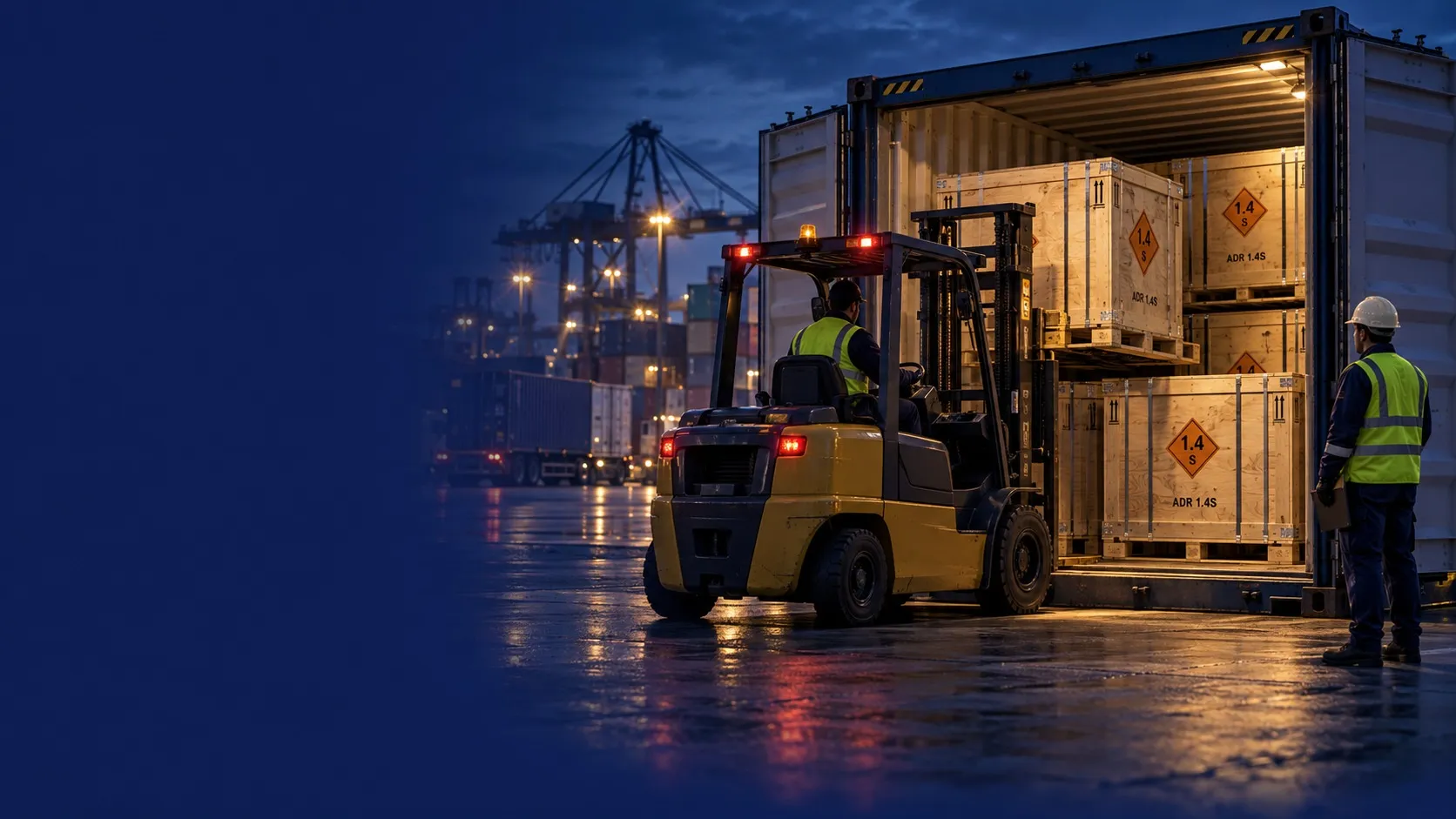
- 1.4S
- Division 1.4, compatibility group S: explosive articles whose effects, in an incident, are confined within the package. Many small-arms cartridges belong here, such as UN 0012, and are therefore subject to less restrictive transport rules. Read more: Firearms →
- 20′ container
- Standard container with an external length of 20 feet (6.06 m), suitable for heavy, compact goods. Read more: Sea freight →
- 3PL
- Third-Party Logistics: outsourcing logistics activities such as transport, warehousing and distribution to an external provider. Read more: Logistics and warehousing →
- 40′ container
- Standard container with an external length of 40 feet (12.19 m), with roughly twice the volume of a 20-footer. Read more: Sea freight →
- Abnormal load transport
- Transport of loads whose size or weight exceeds road traffic limits: it requires permits, defined routes and in some cases an escort vehicle. Read more: Road freight →
- ADM – Italian Customs and Monopolies Agency
- The Italian tax agency responsible for customs, excise, gaming and tobacco: it receives customs declarations, carries out controls and collects import duties and VAT. Read more: Customs →
- ADN
- European agreement concerning the international carriage of dangerous goods by inland waterways. Read more: Dangerous goods →
- ADR
- International agreement, signed in Geneva in 1957, governing the carriage of dangerous goods by road: classification, packaging, labelling, documents, vehicles and training. It is updated every two years. Read more: Dangerous goods by road (ADR) →
- ADR driver training certificate
- Certificate showing that the driver has completed the specific training required to drive vehicles carrying dangerous goods. It is valid for five years. Read more: Dangerous goods by road (ADR) →
- ADR instructions in writing
- Standard-format sheet carried in the vehicle telling the crew what to do in the event of an accident or emergency. Read more: Dangerous goods by road (ADR) →
- ADR transport document
- Document accompanying dangerous goods by road, showing UN number, proper shipping name, label numbers, packing group, quantity and tunnel restriction code. Read more: Dangerous goods by road (ADR) →
- AEO – Authorised Economic Operator
- Status provided for by the Union Customs Code and granted by customs (in Italy by ADM) to reliable, solvent operators. It exists as AEOC (customs simplifications) and AEOS (security), also combined, and is recognised throughout the EU. Dalè is an AEO. Read more: Customs →
- AES – Automated Export System
- The EU electronic system that handles export declarations and confirmation of exit of goods from the customs territory. Read more: Customs →
- Anti-dumping duty
- Additional duty the EU applies to certain products imported from specific countries at prices below normal value, to protect EU production. Read more: Customs →
- Approved exporter
- Status granted by customs allowing the exporter to declare preferential origin directly on the invoice, without an EUR.1, under the agreements that provide for it. Read more: Customs →
- Articulated truck
- Vehicle made up of a tractor unit and a semi-trailer, usually with a 13.6-metre loading deck that holds 33 EPAL pallets. Read more: Road freight →
- ATA Carnet
- International customs document for duty-free temporary admission of commercial samples, goods for fairs and exhibitions and professional equipment. In Italy it is issued by the Chambers of Commerce and is valid for up to one year. Read more: Customs →
- ATF Form 6
- Import permit issued by the US federal agency ATF to the importer: it is required to import firearms, ammunition and other controlled articles into the United States. Read more: Firearms →
- ATP
- International agreement on the transport of perishable foodstuffs and on the special equipment to be used, such as insulated and refrigerated vehicles. Read more: Road freight →
- AWB – Air Waybill
- Non-negotiable air transport document that evidences the contract with the airline and accompanies the goods. The number has 11 digits: the first three identify the airline. Read more: Air freight →
- B/L – Bill of Lading
- Sea transport document that evidences the contract, acknowledges shipment of the goods and represents them: the holder of the original is entitled to collect them. It can be negotiable, for example “to order”. Read more: Sea freight →
- BAF – Bunker Adjustment Factor
- Surcharge on ocean freight that adjusts the price to changes in fuel costs. Read more: Sea freight →
- Booking
- Reservation of space on a vessel, aircraft or truck. In sea freight the confirmation shows vessel, ports, cut-off and the reference for collecting the empty container.
- Break bulk
- Cargo loaded as individual pieces rather than in containers, for example machinery, plant and out-of-gauge structures. Read more: Sea freight →
- BTI – Binding Tariff Information
- Customs decision, issued at the operator's request, establishing the tariff classification of specific goods. It is valid throughout the EU for three years. Read more: Customs →
- CAF – Currency Adjustment Factor
- Freight surcharge compensating for exchange rate fluctuations. Read more: Sea freight →
- Cargo Aircraft Only (CAO)
- Label indicating that the package may travel only on cargo aircraft and not on passenger aircraft, because it exceeds the limits allowed on the latter. Read more: Dangerous goods by air (IATA DGR) →
- Cargo insurance
- Cover for loss of or damage to goods in transit, separate from the carrier's liability, which is limited by the conventions. The Institute Cargo Clauses (A), (B) and (C) offer progressively narrower cover.
- Carriage paid and carriage forward
- In domestic transport, “carriage paid” (porto franco) means the sender pays the freight; “carriage forward” (porto assegnato) means the consignee pays.
- Carrier
- The party that undertakes, for payment, to move people or goods from one place to another (Article 1678 of the Italian Civil Code): airline, shipowner, road haulier, railway undertaking.
- Cash on delivery (COD)
- Service in which the carrier collects an amount from the consignee on delivery and pays it to the sender.
- Certificate of origin
- Document certifying the non-preferential origin of goods, required by some destination countries or by letters of credit. In Italy it is issued by the Chambers of Commerce. Read more: Customs →
- CFR – Cost and Freight
- The seller pays the freight to the port of destination, but risk passes to the buyer once the goods are on board at the port of shipment. For sea and inland waterway transport only. Read more: Sea freight →
- Chargeable weight
- The weight on which freight is charged: the greater of the actual weight and the volumetric weight of the shipment. Read more: Air freight →
- Charter
- Hire of an entire aircraft or vessel for a specific cargo, when volume, urgency or type of goods are not compatible with scheduled services. Read more: Air freight →
- CIF – Cost, Insurance and Freight
- As CFR, with cargo insurance arranged by the seller; the minimum cover is the restricted Institute Cargo Clauses (C). For sea and inland waterway transport only. Read more: Sea freight →
- CIM
- Uniform rules of the COTIF convention on the international carriage of goods by rail, and the rail consignment note named after them. Read more: Road freight →
- CIP – Carriage and Insurance Paid To
- As CPT, but the seller must also insure the goods for the buyer. Under Incoterms® 2020 the minimum cover is the broad Institute Cargo Clauses (A).
- Class 1 (explosives)
- Class of explosive substances and articles, divided into divisions 1.1 to 1.6 according to the type of hazard and into compatibility groups identified by a letter. It also includes ammunition and pyrotechnic articles. Read more: Dangerous goods →
- Class 9
- Miscellaneous dangerous substances and articles not covered by other classes: for example lithium batteries, dry ice, environmentally hazardous substances and safety devices such as airbags. Read more: Dangerous goods →
- Clearance at authorised premises
- A simplification allowing customs operations to be carried out at the authorised operator's premises instead of at the customs office. Dalè handles import and export under simplified procedures at its Brescia warehouses. Read more: Customs →
- CMR
- The 1956 Geneva Convention on the contract for the international carriage of goods by road, and the consignment note named after it. It limits the carrier's liability to 8.33 SDR per kilogram of gross weight lost or damaged. Read more: Road freight →
- Cold chain
- Keeping goods within a set temperature range throughout the journey, from collection to delivery. It is essential for perishable food and pharmaceuticals. Read more: Air freight →
- Combined Nomenclature (CN)
- The EU's 8-digit goods nomenclature, based on the Harmonized System. It is used in customs declarations, for duties and for Intrastat statistics. Read more: Customs →
- Commercial invoice
- Sales document stating seller, buyer, description of goods, quantity, value and delivery terms. It is the basis of the customs declaration and of the customs value. Read more: Customs →
- Commodity code
- Numeric code classifying goods in the customs tariff. Duty, licences and controls depend on it: wrong classification can lead to tax recovery and penalties. Read more: Customs →
- Consignment note
- Document evidencing the contract of carriage and accompanying the goods: CMR by road, AWB by air, CIM by rail. Read more: Road freight →
- Consolidator
- Operator that combines several shippers' consignments into a single load, such as an LCL container or a consolidated air shipment, issuing its own documents to each shipper.
- Container
- Standard ISO box for intermodal transport. The most common sizes are 20 and 40 feet, with an external width of 8 feet (2.44 m). Read more: Sea freight →
- CPT – Carriage Paid To
- The seller pays carriage to the named place of destination, but risk passes to the buyer when the goods are handed over to the first carrier.
- Cross-docking
- System in which incoming goods are sorted and loaded directly onto outgoing vehicles, with no storage or only very short dwell times. Read more: Logistics and warehousing →
- Curtainsider
- Truck or semi-trailer covered by a sliding or lifting curtain, allowing loading from the sides as well. Read more: Road freight →
- Customs
- The administration that controls goods entering and leaving the customs territory, applies duties and taxes and checks prohibitions and licences. By extension, the formalities needed to import or export. Read more: Customs →
- Customs clearance
- The formalities by which goods are declared to customs, checked and released for the requested procedure, for example import or export. It includes payment or guarantee of duties and taxes. Read more: Customs →
- Customs declaration
- The act by which the procedure to be applied to the goods is indicated to customs, together with the required data: parties, origin, value, tariff classification and documents. It is lodged electronically. Read more: Customs →
- Customs duty
- Charge applied to goods imported into the EU, normally as a percentage of the customs value under the common customs tariff. The rate is the same in every Member State. Read more: Customs →
- Customs entry (bolla doganale)
- Common Italian expression for the customs declaration or the document representing it, such as the SAD on import or the EAD on export. Read more: Customs →
- Customs guarantee
- Security covering the duties and taxes that may become due, for example in transit or customs warehousing. It may be individual, for a single operation, or comprehensive. Read more: Customs →
- Customs representation
- Lodging the declaration on behalf of the importer or exporter. A direct representative acts in the name and on behalf of another person; an indirect representative acts in its own name and is also liable for the customs debt. Read more: Customs →
- Customs transit
- Procedure allowing goods to be moved from one customs office to another with duties and taxes suspended, under a guarantee. In the EU and the common transit countries it is managed through the NCTS electronic system. Read more: Customs →
- Customs value
- The basis for calculating duties: normally the transaction value, i.e. the price paid or payable, plus transport and insurance costs up to the point of entry into the EU. Read more: Customs →
- Customs warehouse
- Authorised warehouse where non-Union goods can be stored without paying duties and VAT until they are released for free circulation or re-exported. Read more: Customs →
- Cut-off
- Deadline by which goods or documents must be delivered to the terminal or carrier for loading on a given flight or vessel.
- Dangerous goods
- Substances and articles that may endanger people, property or the environment during transport. They are divided into 9 classes and travel under rules specific to each mode: ADR by road, RID by rail, IMDG by sea and IATA DGR by air. Read more: Dangerous goods →
- Dangerous Goods Declaration (DGD)
- Document in which the shipper declares that the dangerous goods are correctly classified, packed, marked and labelled. By air it is the Shipper's Declaration for Dangerous Goods required by the IATA DGR. Read more: Dangerous goods by air (IATA DGR) →
- Dangerous Goods Safety Adviser (DGSA)
- Role required by ADR for companies that ship, pack, load or carry dangerous goods: the adviser monitors compliance and draws up an annual report. Read more: Dangerous goods by road (ADR) →
- Dangerous goods storage
- Warehouse area dedicated to dangerous goods, organised according to safety and fire regulations and segregation rules. Dalè stores ADR goods in dedicated areas of its Brescia logistics hub. Read more: Logistics and warehousing →
- DAP – Delivered at Place
- The seller bears costs and risks up to the named place of destination, with the goods ready for unloading from the arriving vehicle. Import clearance, duties and taxes remain with the buyer.
- DDP – Delivered Duty Paid
- The seller delivers the goods at destination cleared for import, also paying the duties and taxes of the country of arrival. It is the rule with the most obligations for the seller.
- DDT – Italian delivery note
- Document under Italian Presidential Decree 472/1996 that accompanies goods moving within Italy and allows deferred invoicing. It shows date, number, supplier, customer, description and quantity of the goods.
- Demurrage
- Charge applied by the shipping line when the container stays in the terminal beyond the free days. Read more: Sea freight →
- Detention
- Charge applied when the container is kept outside the terminal, at the shipper or consignee, beyond the free days granted. Read more: Sea freight →
- Directive (EU) 2021/555
- Directive on control of the acquisition and possession of weapons, which also governs transfers of civilian firearms between EU Member States. Read more: Firearms →
- Documentary collection
- The seller entrusts the shipping documents to its bank, which releases them to the buyer only against payment (D/P) or acceptance of a bill of exchange (D/A). It is governed by the ICC URC 522 rules.
- Door to door
- Service covering the whole journey, from collection at the shipper to delivery to the consignee, with a single point of contact. Read more: Air freight →
- DPU – Delivered at Place Unloaded
- The seller delivers the goods unloaded at the named place of destination. It is the only Incoterms® rule requiring the seller to unload at destination; in the 2020 edition it replaced DAT.
- Dry ice
- Solid carbon dioxide (UN 1845, class 9) used to keep sensitive goods at low temperature. By air the net weight must be declared and the packaging must allow the gas to escape. Read more: Dangerous goods by air (IATA DGR) →
- Dual-use items
- Goods, software and technology that can have both civil and military applications. Their export from the EU is governed by Regulation (EU) 2021/821 and may require an authorisation, issued in Italy by UAMA. Read more: Customs →
- EAD – Export Accompanying Document
- Document that accompanies the goods from the customs office of export to the office of exit from the EU and shows the MRN of the operation. Exit is then confirmed electronically. Read more: Customs →
- EAN code (GTIN)
- GS1 standard barcode uniquely identifying a product in trade, usually with 13 digits. Read more: Logistics and warehousing →
- Embargoes and restrictive measures
- Bans or restrictions on trade with certain countries, persons or categories of goods, adopted by the EU or the UN. Destination, consignee and goods must be checked before every shipment. Read more: Customs →
- EmS
- Emergency Schedules of the IMDG Code: the emergency procedures for fire (F) and spillage (S) assigned to each dangerous good carried by sea. Read more: Dangerous goods by sea (IMDG) →
- EORI number
- Economic Operators Registration and Identification number, mandatory for anyone carrying out customs operations in the EU. For Italian operators it consists of “IT” followed by the tax code. Read more: Customs →
- EPAL pallet (Euro pallet)
- Standard wooden pallet measuring 120 × 80 cm, made and marked to the specifications of the EPAL association. Read more: Logistics and warehousing →
- Escort service
- Escorting of a shipment by dedicated personnel, used for valuable or sensitive goods such as firearms and works of art. Read more: Firearms →
- Essential components
- Firearm components such as barrel, frame, receiver, slide, cylinder, bolt or breech block, subject to the same rules as the firearm itself. Non-essential parts can generally travel as ordinary cargo. Read more: Firearms →
- ETA and ETD
- Estimated Time of Arrival and Estimated Time of Departure: the expected date and time of arrival and departure of a vessel, aircraft or truck.
- EUR.1 movement certificate
- Movement certificate proving preferential origin under many EU agreements, allowing the consignee reduced or zero duties. It is endorsed by the customs office of export. Read more: Customs →
- European Firearms Pass
- Document issued to firearm holders, in Italy by the Questura (police headquarters), allowing them to travel with their own firearms between EU countries, for example for hunting or sport shooting, together with any authorisations required by the countries concerned. Read more: Firearms →
- Excepted quantities (EQ)
- Very small quantities of certain dangerous goods to which most of the rules do not apply, provided suitable packaging and the prescribed mark are used. Read more: Dangerous goods →
- Excise duties
- Taxes on the production or consumption of certain products, such as energy products, alcohol and tobacco. Goods under duty suspension move with the electronic administrative document (e-AD). Read more: Customs →
- Export
- Customs procedure under which Union goods leave the EU customs territory. For VAT purposes the export supply is exempt, provided exit is proven. Read more: Customs →
- Express courier
- Door-to-door service for documents and parcels with an integrated network for collection, transport and delivery. Read more: Air freight →
- EXW – Ex Works
- The seller makes the goods available at its own premises, not loaded and not cleared for export: transport, customs and risks are all for the buyer. It is the rule with the fewest obligations for the seller.
- FAS – Free Alongside Ship
- The seller delivers the goods, cleared for export, alongside the vessel at the named port of shipment. It is used only for sea and inland waterway transport. Read more: Sea freight →
- FCA – Free Carrier
- The seller delivers the goods, cleared for export, to the carrier nominated by the buyer at the agreed place; if that place is the seller's premises, the seller must also load them. It can be used for any mode of transport.
- FCL – Full Container Load
- Shipment in a full container dedicated to a single shipper, who fills and seals it. Read more: Sea freight →
- Feeder vessel
- Small container ship linking minor ports with major hubs, where containers are transferred to ocean-going vessels. Read more: Sea freight →
- FIFO and FEFO
- Picking rules: with FIFO (First In, First Out) the goods received first leave first; with FEFO (First Expired, First Out) the goods with the nearest expiry date leave first. Read more: Logistics and warehousing →
- Flat rack
- Container with a floor and end walls but no side walls or roof, for heavy and out-of-gauge cargo such as machinery. Read more: Sea freight →
- FOB – Free on Board
- The seller delivers the goods, cleared for export, on board the vessel at the port of shipment; from there costs and risks pass to the buyer. It is intended for sea and inland waterway transport; for containerised cargo the ICC suggests FCA as more suitable. Read more: Sea freight →
- Forwarder acting as carrier
- A forwarder that performs the carriage with its own or third-party means, taking on the obligations and rights of the carrier (Article 1741 of the Italian Civil Code).
- Free time
- Days granted free of charge for terminal storage or container use, after which demurrage and detention apply. Read more: Sea freight →
- Free zone
- Area of the EU customs territory where non-Union goods can be brought in without paying duties and VAT. In Italy, one example is the free points of the port of Trieste. Read more: Customs →
- Freight
- The price of transport paid to the carrier. It is “prepaid” if paid at origin and “collect” if paid at destination.
- Freight forwarder
- Under Italian law (Article 1737 of the Civil Code), the party that undertakes to conclude a contract of carriage in its own name and on the customer's behalf and to carry out the related operations.
- Freight village (interporto)
- Logistics complex linking road and rail, with an intermodal terminal, warehouses and freight services. Read more: Road freight →
- FTL – Full Truck Load
- Shipment occupying a whole truck, dedicated to a single customer, with no transhipment between collection and delivery. Read more: Road freight →
- General average
- Principle of maritime law under which extraordinary expenses and sacrifices made to save ship and cargo are shared by all parties involved, including owners of undamaged cargo. It is governed by the York-Antwerp Rules. Read more: Sea freight →
- Goods receiving
- Stage in which incoming goods are unloaded, checked for packages and quantities and recorded in stock. Read more: Logistics and warehousing →
- Groupage
- Consolidation of several shippers' consignments in a single truck, container or flight, to reduce costs when volumes are small. Read more: Road freight →
- Harmonized System (HS)
- International goods nomenclature managed by the World Customs Organization: it classifies products with 6-digit codes used almost worldwide. Read more: Customs →
- Hazard classes
- The 9 classes of dangerous goods: 1 explosives, 2 gases, 3 flammable liquids, 4 flammable solids, 5 oxidizers and organic peroxides, 6 toxic and infectious substances, 7 radioactive material, 8 corrosives, 9 miscellaneous dangerous substances and articles. Read more: Dangerous goods →
- Hazard labels
- Diamond-shaped labels indicating the hazard class of the goods, to be affixed to packages. Larger versions, placards, go on containers, tanks and vehicles. Read more: Dangerous goods →
- High Cube
- Container with an external height of 9 feet 6 inches (2.90 m), about 30 cm more than the standard model. It is most common in the 40-foot length. Read more: Sea freight →
- HT treatment
- Heat treatment of wood packaging under ISPM 15: at least 56 °C at the core of the wood for at least 30 consecutive minutes. Read more: Logistics and warehousing →
- Hub
- Node where shipments from several origins are concentrated and sorted towards their destinations, such as a major cargo airport or a transhipment port.
- IATA cargo agent
- Freight forwarder accredited by IATA that books and issues air waybills directly with airlines. Dalè is an IATA cargo agent. Read more: Air freight →
- IATA DGR
- Dangerous Goods Regulations: manual published every year by IATA, based on the ICAO Technical Instructions, setting out how to ship dangerous goods by air. States and airlines may add their own restrictions (variations). Read more: Dangerous goods by air (IATA DGR) →
- ICAO Technical Instructions
- Standard of ICAO, the UN civil aviation agency, on the safe transport of dangerous goods by air. It is the legal reference on which the IATA DGR are based. Read more: Dangerous goods by air (IATA DGR) →
- ICS2 and ENS
- ICS2 is the EU system for advance safety and security information on incoming goods. The data are filed in the entry summary declaration (ENS), before loading or arrival depending on the mode of transport. Read more: Customs →
- IMDG Code
- The IMO's International Maritime Dangerous Goods Code: mandatory under the SOLAS convention for the carriage of packaged dangerous goods by sea. It is updated every two years. Read more: Dangerous goods by sea (IMDG) →
- Import VAT
- Tax due on goods imported and released for consumption, calculated on the customs value plus duties and incidental costs up to the place of destination. Read more: Customs →
- Incoterms®
- Rules published by the International Chamber of Commerce (ICC) that use three-letter codes to define how seller and buyer share the costs, risks and formalities of a shipment. The current edition is Incoterms® 2020, with 11 rules. They do not govern price or transfer of ownership.
- Industrial pallet
- Pallet measuring 120 × 100 cm, common for industrial and chemical goods and in sea freight. Read more: Logistics and warehousing →
- Intermodal transport
- Transport in which the goods stay in the same load unit, such as a container, swap body or semi-trailer, and move from one mode to another without being handled. Read more: Road freight →
- Intra-EU supply
- Sale of goods to a VAT-registered business in another EU Member State, with the goods transported out of Italy. It is VAT-exempt if the buyer has a valid VAT number in VIES and transport is proven. Read more: Customs →
- Intrastat
- Summary returns of supplies and purchases of goods and services with operators in other EU Member States, sent to the Italian Customs Agency for tax and statistical purposes. Frequency and content depend on trade volumes. Read more: Customs →
- Inward processing
- Procedure allowing non-Union goods to be imported for working, processing or repair in the EU with duties and VAT suspended, provided the resulting products are re-exported. It requires a customs authorisation. Read more: Customs →
- ISF (10+2)
- Importer Security Filing: security data the importer must submit to US Customs and Border Protection (CBP) at least 24 hours before the goods are loaded on a vessel bound for the United States. Read more: Sea freight →
- ISPM 15
- International FAO phytosanitary standard for wood packaging such as pallets and crates: the wood must be treated, usually by heat (HT), and marked with the IPPC symbol. Many non-EU countries require it; processed wood such as plywood and OSB is excluded. Read more: Logistics and warehousing →
- ISPS Code
- International Ship and Port Facility Security Code, part of the SOLAS convention and in force since 2004. Read more: Sea freight →
- Kemler code (hazard identification number)
- Hazard identification number shown in the upper half of the orange plate: the digits indicate the type of hazard, for example 33 for a highly flammable liquid. An X in front means the substance reacts dangerously with water. Read more: Dangerous goods by road (ADR) →
- Kitting
- Assembling kits or packs of several different items in the warehouse, for example a product with its accessories, before shipment. Read more: Logistics and warehousing →
- Known consignor
- Shipper approved by the aviation security authority, in Italy ENAC, that applies security controls to its own shipments, so the cargo can be loaded without further screening. Read more: Air freight →
- Labelling
- Applying to packages and products the labels required by the customer, the market or regulations, such as codes, addresses or hazard labels. Read more: Logistics and warehousing →
- Last mile
- The final stage of delivery, from the local depot or hub to the consignee.
- Law 185/1990
- Italian law on the control of export, import and transit of military equipment. Authorisations are issued by UAMA. Read more: Firearms →
- LCL – Less than Container Load
- Sea shipment that does not fill a container: it travels with other shippers' goods in a consolidated container. Read more: Sea freight →
- Lead time
- Time between the order and the availability or delivery of the goods.
- Letter of credit (documentary credit)
- A bank's undertaking to pay the seller against presentation of compliant documents, such as the bill of lading. It is normally governed by the ICC UCP 600 rules.
- Letter of intent (VAT)
- Declaration by which a regular exporter asks its suppliers to invoice without Italian VAT, within the ceiling (plafond) built up through exports. It must be sent to the Italian Revenue Agency before the transaction.
- Licensed customs agent (doganalista)
- Professional registered in the Italian register established by Law 1612/1960, qualified to represent operators in customs operations. Read more: Customs →
- Limited quantities (LQ)
- Dangerous goods in small inner packagings, within the limits set for each UN number. They travel under simplified rules and packages need only the diamond-shaped mark with black top and bottom. Read more: Dangerous goods →
- Lithium batteries
- Class 9 dangerous goods: UN 3480 (lithium ion) and UN 3090 (lithium metal) when shipped on their own, UN 3481 and UN 3091 when packed with or contained in equipment. By air they are subject to particularly strict rules. Read more: Dangerous goods by air (IATA DGR) →
- Load unit
- Goods grouped together to be handled as a single piece, for example a pallet, a crate or a container. Read more: Logistics and warehousing →
- Loading dock
- Point where the truck docks at the warehouse, level with the loading deck, for loading and unloading with pallet trucks and forklifts. Dalè's Brescia hub has 18 loading docks. Read more: Logistics and warehousing →
- Loading metre (LDM)
- Unit measuring the space occupied on the truck deck, in length across the full width. It is used to price part loads and groupage. Read more: Road freight →
- Logistics
- The activities managing the physical flow of goods: receiving, storage, order preparation, transport and distribution. Read more: Logistics and warehousing →
- LTL – Less than Truck Load
- Shipment occupying only part of the truck, which is shared with other consignments. Read more: Road freight →
- Marine pollutant
- Substance harmful to the aquatic environment under the IMDG Code. Packages and containers must bear the mark showing a fish and a tree. Read more: Dangerous goods by sea (IMDG) →
- Master B/L and House B/L
- The Master B/L is issued by the shipping line to the forwarder; the House B/L is issued by the forwarder to each individual shipper, for example in groupage. Read more: Sea freight →
- MAWB and HAWB
- The Master AWB is issued by the airline for the whole consolidated shipment; the House AWB is issued by the forwarder to each shipper within the consolidation. Read more: Air freight →
- MRN – Movement Reference Number
- 18-character alphanumeric code assigned by the customs system to each export, transit or import declaration. It identifies the operation and allows its status to be followed. Read more: Customs →
- Multimodal transport
- Transport using at least two different modes under a single contract, with one operator responsible for the entire journey.
- National Proof House
- Public body based in Gardone Val Trompia (Brescia) that proof-tests and marks portable firearms and checks commercial ammunition before they are placed on the Italian market. Read more: Firearms →
- NCTS
- New Computerised Transit System: the European electronic system managing Union and common transit, from opening to discharge of the operation. Read more: Customs →
- NVOCC
- Non-Vessel Operating Common Carrier: an operator acting as an ocean carrier and issuing its own bills of lading without owning vessels, buying space from shipping lines. Read more: Sea freight →
- Open top
- Container without a rigid roof, covered by a tarpaulin, for goods loaded from above by crane or taller than standard. Read more: Sea freight →
- Orange plate
- Rectangular orange plate displayed on vehicles carrying dangerous goods. In the numbered version it shows the hazard identification number at the top and the UN number at the bottom. Read more: Dangerous goods by road (ADR) →
- Origin of goods
- The “economic nationality” of goods. Non-preferential origin is used for measures such as anti-dumping, embargoes and marking; preferential origin allows reduced or zero duties under EU trade agreements. Read more: Customs →
- Out of gauge
- Cargo whose dimensions exceed the standard profile of the vehicle or container and require dedicated solutions, such as flat racks, open tops or abnormal load transport. Read more: Road freight →
- Outward processing
- Procedure allowing Union goods to be temporarily exported for processing or repair outside the EU and the resulting products to be re-imported with total or partial relief from duties. It requires a customs authorisation. Read more: Customs →
- Overpack
- Enclosure used by a single shipper to combine one or more packages into a unit easier to handle, for example a stretch-wrapped pallet. It must be marked “OVERPACK” and repeat the package markings if they are not visible. Read more: Dangerous goods →
- Package
- Each individual unit of a shipment, such as a crate, carton or pallet, with its own marks and weight.
- Packing group
- Indicates the degree of danger of many dangerous goods: I high, II medium, III low. It determines which approved packagings may be used. Read more: Dangerous goods →
- Packing list
- List of the packages in a shipment with contents, weights, dimensions and marks. It makes customs checks and verification on delivery easier.
- Pallet racking
- Multi-level steel structure for storing pallets at height, accessed by forklift trucks. Read more: Logistics and warehousing →
- Pallet space
- Space taken up by one pallet on a vehicle or in a warehouse; a common unit for pricing transport and storage. Read more: Logistics and warehousing →
- Palletisation
- Placing goods on pallets and securing them, for example with stretch film and strapping, so they can be handled mechanically. Read more: Logistics and warehousing →
- Physical inspection
- Physical examination ordered by customs to check that quantity, quality and nature of the goods match the declaration. It may be replaced or supplemented by a scanner check. Read more: Customs →
- Pick & pack
- Picking products and packing them into a parcel ready for shipment. Read more: Logistics and warehousing →
- Picking
- Taking products from warehouse locations to prepare orders, by full case or by single item. Read more: Logistics and warehousing →
- POD – Proof of Delivery
- Evidence of delivery: a document or electronic record signed by the consignee, showing the date and time of delivery.
- Pro forma invoice
- Document that anticipates the content of the final invoice. It is used for quotations, advance payments, opening letters of credit and for shipments without a sale, such as samples or goods sent for repair. Read more: Customs →
- Proof of exit
- Electronic confirmation that exported goods have left the EU customs territory. It is the evidence the exporter uses to support the VAT exemption of the export supply. Read more: Customs →
- Proper shipping name
- The name under which a dangerous good must be shown on documents and packages, taken from the dangerous goods list of the applicable regulations. Read more: Dangerous goods →
- Reefer
- Refrigerated container with its own cooling unit, for temperature-controlled goods. Read more: Sea freight →
- Regulated agent
- Operator approved by ENAC that applies the security controls required by EU law to air cargo, for example X-ray screening, before handing it to the airline. Read more: Air freight →
- Regulation (EU) 258/2012
- Regulation governing the export, import and transit of civilian firearms, their parts, essential components and ammunition between the EU and third countries, with the related authorisations. Read more: Firearms →
- Release for free circulation
- Customs procedure giving non-Union goods the status of Union goods, with payment of duties and application of commercial policy measures. Together with release for consumption it also triggers payment of import VAT. Read more: Customs →
- Release of goods
- The act by which customs places the goods at the disposal of the declarant for the requested procedure, after any checks and payment or guarantee of duties. Read more: Customs →
- Reservation on delivery
- Note by which the consignee records damage or shortage on the transport document at delivery. Under the CMR, for non-apparent damage a written reservation must be sent within 7 days, excluding Sundays and public holidays. Read more: Road freight →
- Reverse logistics
- Management of return flows: customer returns, repairs, reusable packaging and goods to be recovered or disposed of. Read more: Logistics and warehousing →
- REX – Registered Exporter system
- EU system in which registered exporters certify preferential origin with a statement on the invoice or another commercial document, instead of a certificate. Read more: Customs →
- RID
- Regulations for the international carriage of dangerous goods by rail, annexed to the COTIF convention. Its structure is almost identical to ADR. Read more: Dangerous goods →
- Rigid truck
- Truck with a fixed body, shorter than an articulated truck, used for medium loads and for deliveries to areas with restricted access. Read more: Road freight →
- Ro-Ro
- Roll-on/roll-off: vessel onto which cargo is driven on wheels, such as trucks, semi-trailers or vehicles, via ramps. Read more: Sea freight →
- Road cabotage
- Transport within a country by a haulier established in another country. In the EU it is allowed within limits: at most three operations within seven days after an international journey. Read more: Road freight →
- SAD – Single Administrative Document
- The customs declaration form used for years throughout the EU for import, export and transit. The name is still in common use after the move to fully electronic declarations. Read more: Customs →
- Safety Data Sheet (SDS)
- 16-section document required by the REACH regulation describing the hazards and safe handling of a substance or mixture. Section 14 gives the transport information, such as UN number and class. Read more: Dangerous goods by road (ADR) →
- Screening
- Security check of air cargo by X-ray, explosive trace detection or other methods, for shipments that do not come from a secure supply chain. Read more: Air freight →
- SDR – Special Drawing Right
- International Monetary Fund unit of account based on a basket of currencies. Transport conventions use it to set compensation limits, for example 8.33 SDR per kilogram under the CMR.
- Sea Waybill
- Non-negotiable sea transport document: the goods are delivered to the named consignee without presentation of an original. Read more: Sea freight →
- Sea-air
- Combined sea and air transport: the goods travel by sea to a hub and continue by air, balancing time and cost between the two modes. Read more: Sea freight →
- Segregation
- Mandatory separation of incompatible dangerous goods, for example oxidizers and flammables, in the vehicle, container, hold or warehouse. Read more: Dangerous goods →
- Shipper, consignee and notify party
- The parties named on transport documents: the shipper sends the goods, the consignee receives them and the notify party is to be advised when the goods arrive.
- Shipping marks
- Text and symbols on packages that allow them to be identified and handled correctly: consignee, numbering, weights and symbols such as “this way up” and “fragile”.
- SKU
- Stock Keeping Unit: code identifying each individual item held in stock, including variants such as size or colour. Read more: Logistics and warehousing →
- SOLAS
- The IMO International Convention for the Safety of Life at Sea. Among other things it makes the IMDG Code and container weight verification (VGM) mandatory. Read more: Sea freight →
- Stocktaking
- Counting and checking goods in stock to reconcile physical quantities with recorded ones. Read more: Logistics and warehousing →
- Storage
- Keeping goods in a warehouse pending shipment or delivery. Read more: Logistics and warehousing →
- Swap body
- Interchangeable load unit that detaches from the truck and can also travel by rail; unlike a container, it is normally not stackable. Read more: Road freight →
- T1
- External transit declaration for non-Union goods travelling with duties and taxes suspended. It is opened at the office of departure and discharged at the office of destination. Read more: Customs →
- T2
- Transit declaration for Union goods, used mainly when they cross a common transit country, such as Switzerland, to retain their Union status. Read more: Customs →
- Tail lift
- Platform fitted at the rear of the truck for loading and unloading when no dock or forklift is available. Read more: Road freight →
- TARIC
- The integrated tariff of the EU: it adds 10-digit subdivisions to the Combined Nomenclature together with all applicable measures, such as preferential duties, anti-dumping, suspensions, quotas and restrictions. Read more: Customs →
- Telex release
- Release of the goods at destination without original bills of lading, after the originals have been surrendered to the carrier at origin. It is used when documents do not need to circulate. Read more: Sea freight →
- Temporary admission
- Procedure allowing non-Union goods intended for re-export without changes to be used in the EU with total or partial relief from duties. It is used, for example, for fairs, exhibitions and equipment. Read more: Customs →
- Temporary export
- Exit from the EU of Union goods that are due to return, for example for fairs, exhibitions, tests or repairs. On return the goods can benefit from duty relief as returned goods. Read more: Customs →
- Temporary storage
- Status of non-Union goods from their arrival in the EU until they are placed under a customs procedure. It may last a maximum of 90 days. Read more: Customs →
- Terms of delivery (resa)
- In Italian trade usage, the delivery condition agreed between seller and buyer, usually expressed as an Incoterm® plus a place, for example “FCA Brescia”.
- TEU
- Twenty-foot Equivalent Unit: unit equal to one 20-foot container, used for the capacity of ships and ports. A 40-foot container counts as 2 TEU. Read more: Sea freight →
- THC – Terminal Handling Charges
- Charges for handling the container at the port terminal, on loading and discharge. Read more: Sea freight →
- Third-party warehouse
- Warehouse run by a logistics provider that stores and handles goods owned by its customers. Read more: Logistics and warehousing →
- TIR Carnet
- International transit document under the UN TIR Convention: it allows sealed vehicles and containers to cross several borders with reduced checks and a single guarantee. Read more: Road freight →
- Tracking
- Monitoring of a shipment's location and status throughout the journey, using the shipment number or vehicle data.
- Transhipment
- Transfer of goods or a container from one vessel, or vehicle, to another at an intermediate port or hub before the final destination. Read more: Sea freight →
- Tunnel restriction code
- ADR code, for example B, C/D or E, indicating which tunnel categories a vehicle carrying those dangerous goods may not pass through. It must be shown on the transport document. Read more: Dangerous goods by road (ADR) →
- UAMA
- Italy's Unit for the Authorisation of Armament Materials, part of the Ministry of Foreign Affairs and International Cooperation. It issues the authorisations for military equipment under Law 185/1990 and those for dual-use items. Read more: Firearms →
- UCC – Union Customs Code
- Regulation (EU) No 952/2013, applicable since 1 May 2016: the customs law common to all Member States, supplemented by delegated and implementing regulations. Read more: Customs →
- ULD – Unit Load Device
- Aircraft pallets and containers in which cargo is loaded into the aircraft hold. Read more: Air freight →
- UN Model Regulations (Orange Book)
- The UN Recommendations on the Transport of Dangerous Goods (Model Regulations), known as the “Orange Book” from the colour of their cover. They are the common basis of ADR, RID, IMDG and IATA DGR. Read more: Dangerous goods →
- UN number
- Four-digit number identifying a dangerous substance or article, for example UN 1203 for petrol. It must appear on the documents and, preceded by the letters “UN”, on the packages. Read more: Dangerous goods →
- UN specification packaging
- Packaging tested to the UN recommendations and marked with the “UN” symbol and a code showing type, permitted packing groups, maximum mass or density, year and country of approval. Read more: Dangerous goods →
- Undeliverable shipment on hold
- Status of goods that cannot be delivered, for example because the consignee is absent or refuses them, and are held by the carrier pending instructions. Storage charges may apply.
- Union and non-Union goods
- Union goods are those wholly obtained in the EU, those imported and released for free circulation, and those obtained from both. All other goods are non-Union goods and remain under customs supervision. Read more: Customs →
- VAT warehouse
- Warehouse provided for by Italian law (Article 50-bis of Decree-Law 331/1993) where certain goods can be stored without VAT being charged until they are removed. Read more: Customs →
- VGM – Verified Gross Mass
- Gross weight of the packed container, verified and declared by the shipper before loading as required by the SOLAS convention since 1 July 2016. Without a VGM the container cannot be loaded. Read more: Sea freight →
- VIES
- European Commission system for checking the validity of VAT numbers of businesses trading within the EU.
- Volumetric weight
- Notional weight calculated from the volume of the packages. In air freight the standard ratio is 1:6000, so 1 m³ equals 167 kg; couriers and road transport use different ratios. Read more: Air freight →
- WMS
- Warehouse Management System: software managing locations, stock, receipts, picking and dispatch in the warehouse. Read more: Logistics and warehousing →
- Wooden crate
- Custom rigid packaging for heavy, fragile or valuable goods, such as machinery and works of art. For export outside the EU it should normally be made of ISPM 15 compliant wood. Read more: Logistics and warehousing →