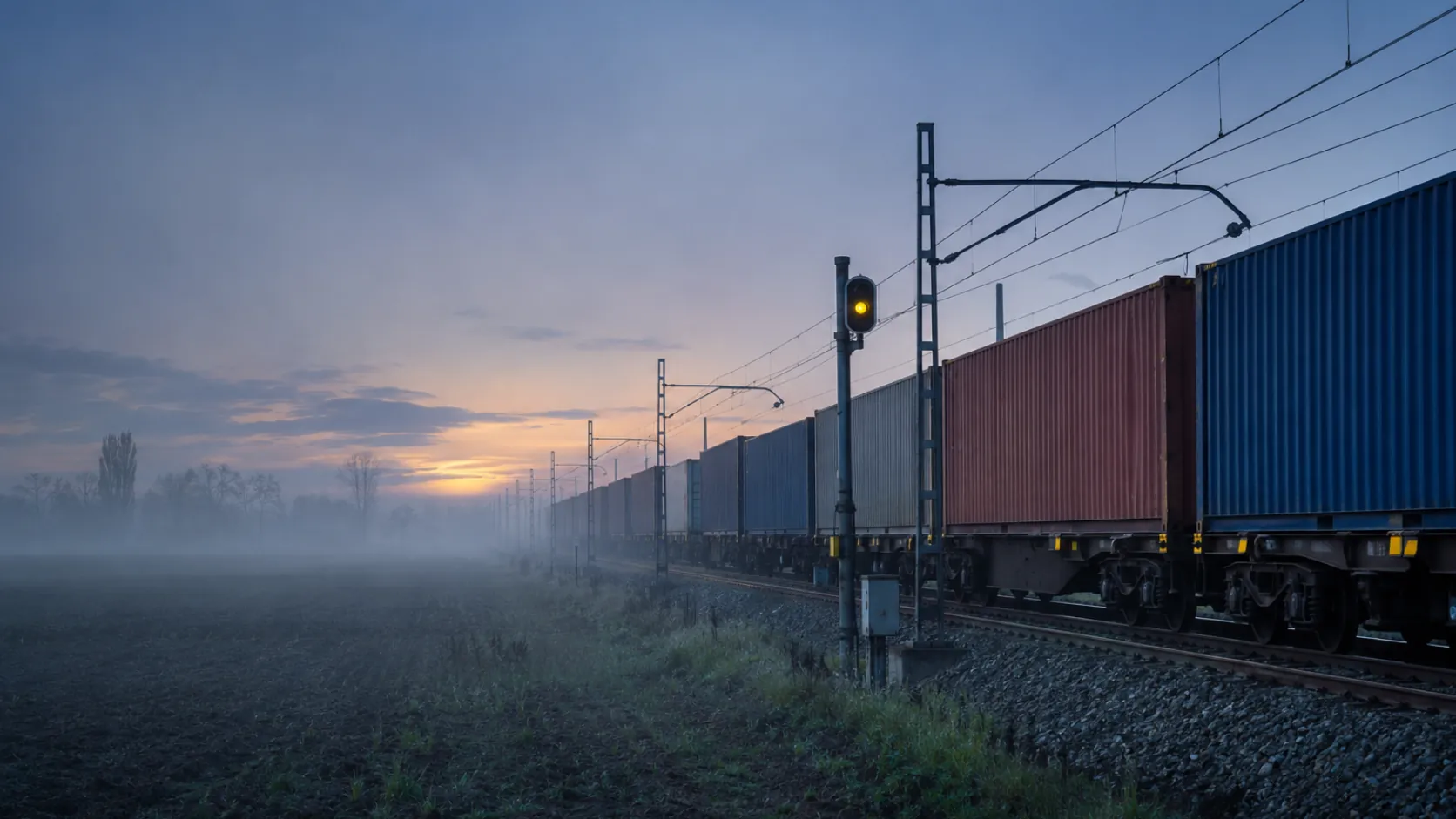
What a railway wagon is
A wagon is a vehicle hauled by a locomotive. It has a frame, bogies with wheels, a braking system and a coupling system, and on top of these a structure that changes according to the goods: a closed body, a flat deck, a hopper, a tank. Several coupled wagons form a train, which can be a block train or a train made up of wagons from different customers.
In Europe wagons run across several networks, so they must follow common safety and maintenance rules. Every wagon has an identification number and an entity in charge of maintenance. This makes it possible to trace the vehicle and know its characteristics: payload, tare weight, length, type of brake, lines on which it may run.
The main types of wagon
- Closed wagons. With walls and a roof, they protect goods sensitive to rain: pallets of packaged products, paper, coils, food products. Some have sliding walls so that they can be loaded by forklift from several sides.
- Open wagons with side walls. For goods that do not mind rain or that are loaded with cranes and grabs: scrap, aggregates, timber, coal, steel products.
- Flat wagons. A platform without high sides: for pipes, beams, machinery, vehicles and, above all, containers and swap bodies, secured with dedicated pins.
- Hopper wagons. With discharge openings at the bottom, for bulk products such as grain, cement and sand.
- Tank wagons. For liquids and gases, including dangerous ones, with specific requirements and periodic inspections.
- Low-floor or pocket wagons. For semi-trailers and tall loads, which make it possible to stay within the loading gauge of tunnels.
- Temperature-controlled or insulated wagons. For goods sensitive to cold or heat, when the service is available on the route.
What to look at before choosing
Choosing the wagon is not a matter of picking from a catalogue. What counts:
- Payload and tare. The payload is how much can be loaded; the tare is the weight of the empty vehicle. Added together they give the total weight, to be compared with the axle limits of the lines.
- Usable dimensions. Length and width of the deck or body, height of the walls.
- Loading gauge. The loaded wagon must fit within the profile allowed on the lines.
- Loading and unloading system. From above, from the side, from the bottom; with what equipment (crane, forklift, reach stacker, grab).
- Load securing. The lashing must withstand the stresses of the train, which differ from those on the road.
Common rules and responsibilities
In international rail transport the contract is based on uniform rules, which provide for a railway consignment note; the CIM entry in the glossary describes them. For dangerous goods the RID applies, harmonised with the ADR for road, and the tank wagon or the wagon for packaged dangerous goods must have the required characteristics. Private wagons too, owned by the customer or by a lessor, must have an entity in charge of maintenance and follow the same rules.
A practical example
A company in Brescia has to ship lots of steel rebar to Germany. If the weight and length are regular, a flat wagon with side walls is suitable; if the goods are finished and need protection from rain, you need a wagon with a sliding cover. For a few pallets of packaged products, on the other hand, a whole wagon makes no sense: a container on a container wagon, or a lorry, is better.
Common mistakes
- Choosing a wagon only by type of goods and not by the unloading system available at the destination.
If you are considering rail transport, Dalè helps you work out whether a wagon, a container on a train or another mode is the better fit, using your weights and your dimensions.
Sources
A shipment to organise?
Tell us what you are shipping and where to: we reply with the route, the documents required and a quote.
Related Dalè services
Related glossary terms

