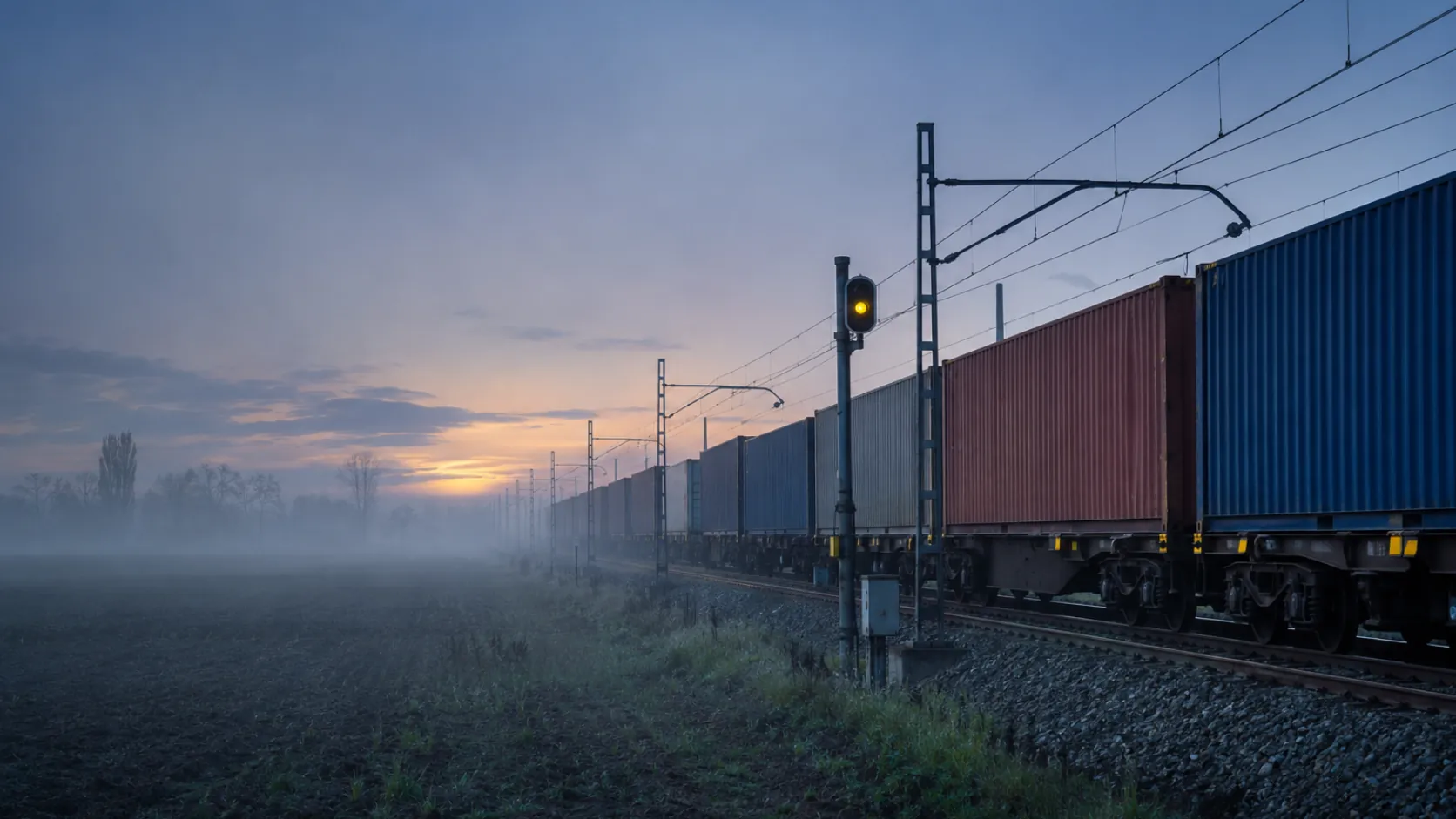
What the gauge is and why it exists
A train runs on a track surrounded by fixed structures: tunnels, underpasses, bridges, canopies, overhead lines, signals. The free space around the track is not the same on every line, because European railways were built at different times and by different operators. The gauge is the geometric translation of this space: a shape, drawn on the cross-section of the track, that shows how far the width and height of the wagon and its cargo can extend.
There are in fact two linked shapes. On one side is the vehicle gauge, that is, how much space the wagon can occupy, including sway on curves and suspension movement. On the other is the infrastructure gauge, that is, the space the line leaves free. The first profile must always sit inside the second, with a margin. That is why we talk about compatibility between vehicle and line, not about a single figure valid everywhere.
Gauge codes in Europe
On the European network, the technical specifications for interoperability for infrastructure (Regulation (EU) No 1299/2014) define several reference profiles, known by the codes GA, GB and GC, with variants added to them. The same regulation points out that a vehicle conforming to a larger gauge is not automatically compatible with every line: a GC-gauge vehicle, for example, cannot pass through a tunnel built for the GB gauge.
For intermodal transport, dedicated profile codes are also used. They describe which loading units (containers, swap bodies, semi-trailers) can be loaded on which wagons and for which lines. The check is made route by route, not country by country.
Containers, semi-trailers and height
The issue arises mainly with tall loading units. A high cube container is taller than a standard one; a semi-trailer with its corner height requires low-floor wagons and lines with a suitable gauge. European freight corridors have been adapted over the years precisely to take these units, and the regulation on the trans-European transport network (Regulation (EU) 2024/1679) lists among the parameters to be achieved a gauge that allows the carriage of semi-trailers up to 4 metres high, along with trains 740 metres long, with staggered deadlines up to 2050.
When the load is out of gauge
A load that exceeds the ordinary gauge, such as a transformer, a turbine or a steel structure, can travel only with a special authorisation and a planned route. The infrastructure manager (in Italy, RFI) checks compatibility with each section, indicates the usable lines and any conditions, such as reduced speed or a ban on passing other trains. A special wagon is often needed as well.
If the train is not feasible, the options left are abnormal-load road transport and break bulk by sea. The choice depends on dimensions, weight, and the points of departure and arrival. A typical case is out-of-gauge cargo on a flat rack: what is acceptable on a ship may not be on some railway lines.
How to approach it with your forwarder
If you have bulky cargo, send length, width, height and weight, together with the route you want. Dalè compares rail with road and sea and, if the gauge is the limit, proposes the most suitable alternative. For containers, the container guide page explains the standard dimensions.
Sources
- EUR-Lex – Regulation (EU) No 1299/2014 (infrastructure TSI)
- EUR-Lex – Regulation (EU) 2024/1679 (TEN-T networks)
A shipment to organise?
Tell us what you are shipping and where to: we reply with the route, the documents required and a quote.
Related Dalè services
Related glossary terms

