What it is
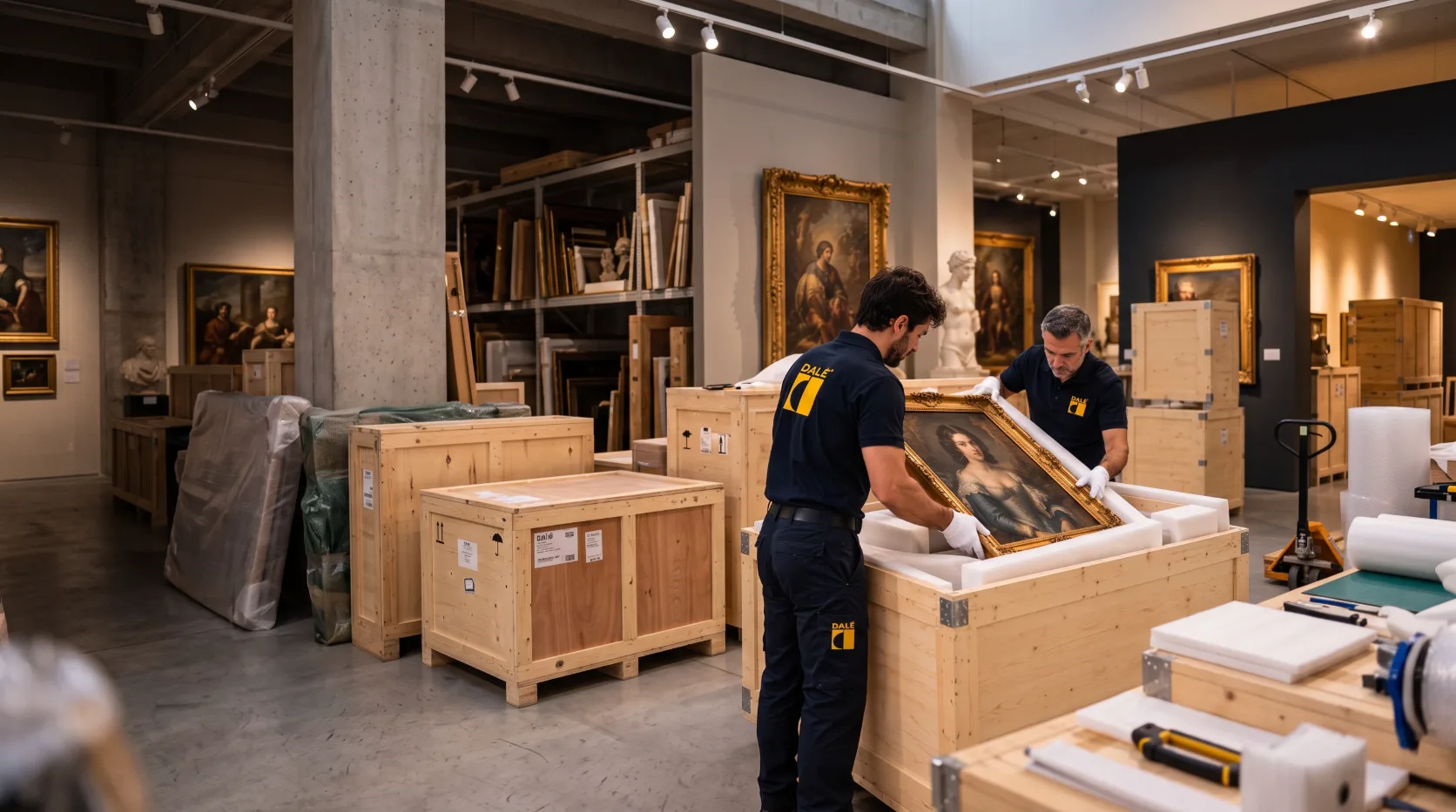
"Museum" refers to the construction standard museums require for loans and moves: a container designed for that work, with its dimensions, its weight and its weak points, planned by looking at the condition report.
"Climate-controlled" does not mean there is an air-conditioning system inside. In most cases it is a passive-climate crate: insulating layers and seals reduce the exchange with the outside, so internal temperature and humidity change slowly.
How it is built
- Outer wooden shell. Boards or panels that withstand impacts, lifting and stacking, with a reinforced base for forks and pallet trucks. For shipments outside the Union, solid wood must comply with the ISPM 15 standard.
- Insulating layer. Panels or sheets of closed-cell materials, chosen for their thermal behaviour and their ability to absorb blows.
- Inner crate and supports. For the most fragile works a double crate is often used, with the work suspended in an inner crate that floats inside the outer one. The work rests on shaped supports and not on materials that press on the surface.
- Vapour barrier and humidity buffer. A vapour-proof film and, at times, materials that absorb or release moisture help keep the internal microclimate stable.
Why a stable climate matters
Canvas, panel, paper, wood and gilded frames react to temperature and humidity: they expand, shrink and sometimes crack. The danger lies in the swing more than in the value itself. A journey that goes from a cold warehouse to a heated room, or from an aircraft into tropical humidity, can stress the work. The crate does not cancel these variations but slows them. That is why, on arrival, the crate is normally left closed for an acclimatisation period before it is opened: the times and reference values are given by the lender, in the loan agreement or in a technical sheet.
When it is needed and when something else is enough
A museum crate is the right choice for fragile, heavy or high-value works, for long journeys, for air or sea shipments and for loans that pass through several hands. For a short trip in a dedicated vehicle, well-executed soft packing may be enough: the difference from soft packing is decided work by work, after seeing dimensions and photographs. See also the entry on packing works of art.
Practical example
A sixteenth-century oil on panel travels from a collection in Brescia to an exhibition in a non-EU country. The panel is sensitive to humidity. A double ISPM 15 wooden crate is built, with insulation and supports shaped to the back of the panel; the courier, described in the entry on the courier, attends the closing. On arrival the crate stays closed until the internal temperature matches that of the room. The loan is covered by a nail-to-nail policy.
Common mistakes
- Building the crate to the dimensions of the work without the frame, base or mount.
- Using padding materials unsuitable for the technique: some rubbers and plastics release substances that damage varnishes and metals.
- Opening the crate as soon as it arrives, without letting it acclimatise.
Dalè designs and builds made-to-measure wooden crates at its hub in Brescia; for the most delicate works, the type of crate is decided after seeing dimensions, technique and photographs.
Sources
A shipment to organise?
Tell us what you are shipping and where to: we reply with the route, the documents required and a quote.
Related Dalè services
Related glossary terms

