The basic difference
In everyday speech “trailer” means anything a lorry pulls behind it, but technically they are two different vehicles. The Italian Highway Code (Article 54) lists them as separate vehicle categories, and the distinction matters for driving licences, length limits, insurance and registration.
- Trailer. It has its own front and rear axles and is coupled to the towing vehicle with a drawbar. Its weight rests entirely on its own wheels. It is used behind a rigid truck, forming a drawbar combination (road train).
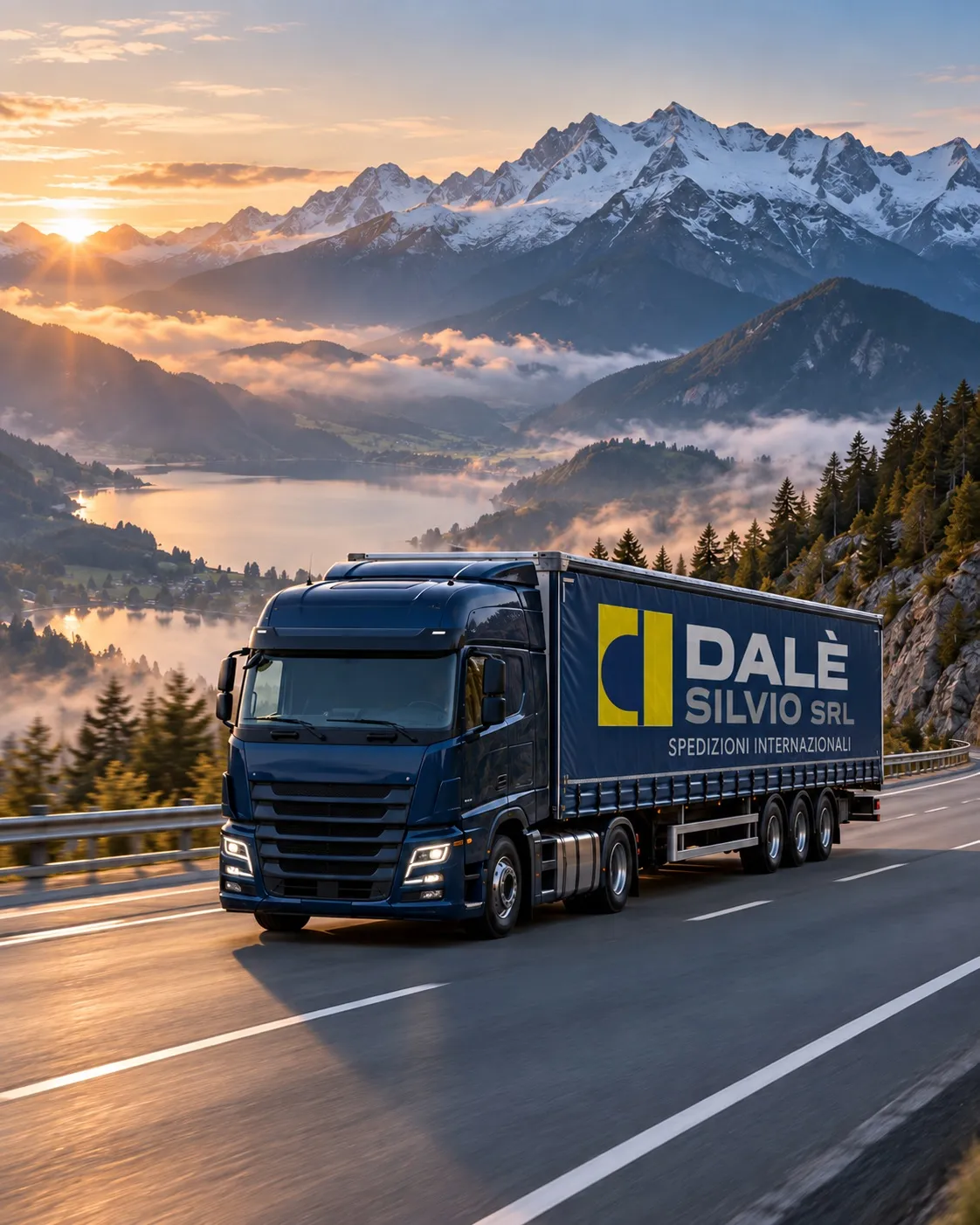
- Semi-trailer. It has axles only at the rear. The front end rests on the fifth wheel of the tractor unit, a plate to which the semi-trailer's king-pin is fixed. Together they form an articulated lorry. Without a tractor unit, the semi-trailer stands on its landing legs.
This is why a semi-trailer can be left in a yard, a port or a terminal without tying up the tractor: another tractor can pick it up and take it away. It is the feature that made much of intermodal transport possible.
Typical dimensions and capacity
The most common semi-trailer in international transport is the curtainsider with a flat bed of about 13.6 metres and an internal width of just under 2.5 metres, which loads up to 33 Euro pallets in a single row. For pallet dimensions and how to work out the spaces, see how many pallets fit in a lorry and the EPAL pallet.
European Directive 96/53/EC sets a maximum length of 16.50 metres for articulated vehicles and 18.75 metres for drawbar combinations. In Italy, Article 216 of the implementing regulation gives 16.50 metres for articulated vehicles, and Article 61 of the Italian Highway Code allows up to 18.75 metres for drawbar combinations and articulated vehicles, under specific conditions. These are limits for the whole combination: the tractor and the coupled semi-trailer count together, not the box alone. The permitted gross vehicle weight, which depends on the number of axles, has its own entry.
There are many versions of semi-trailer, depending on the goods:
- curtainsider or tilt, with sliding or removable sides for loading from the side or from above;
- box van, closed and rigid, offering more protection;
- temperature-controlled, with a refrigeration unit;
- flatbed or low-loader, for machinery and tall loads;
- container chassis, with twist-locks to secure ISO containers;
- tanker, for liquids and powders.
Why the semi-trailer is the basis of combined transport
In combined transport and ro-ro, the goods are not handled when the mode changes: the whole loading unit moves from road to ship or train. The semi-trailer suits this because it has no engine, which is the most expensive part and useless during the crossing.
- By ship. The semi-trailer is taken on board by a port tractor, lashed to the deck and collected on arrival by another tractor. This is unaccompanied transport, described on the page about ro-ro and combined road-sea transport.
- By train. The semi-trailer has to be loaded onto special wagons with a crane or with horizontal systems. Not all semi-trailers are suitable: they must be prepared for lifting and respect the rail loading gauge of the line. A “craneable” semi-trailer has reinforcements and dedicated lifting points.
Common mistakes
- Assuming that any semi-trailer can travel by train: vehicles that are not prepared are refused at the terminal.
- Forgetting that heights are binding on ships and on some railway lines.
- Confusing the weight limits of the semi-trailer alone with those of the whole combination.
- Not checking the vehicle length on routes with hairpin bends or roadworks.
For road shipments, full or part load, you will find the solutions on the road transport page; Dalè sets them up from its Brescia hub, choosing the right vehicle for the load together with you.
Sources
A shipment to organise?
Tell us what you are shipping and where to: we reply with the route, the documents required and a quote.
Related Dalè services
Related glossary terms

