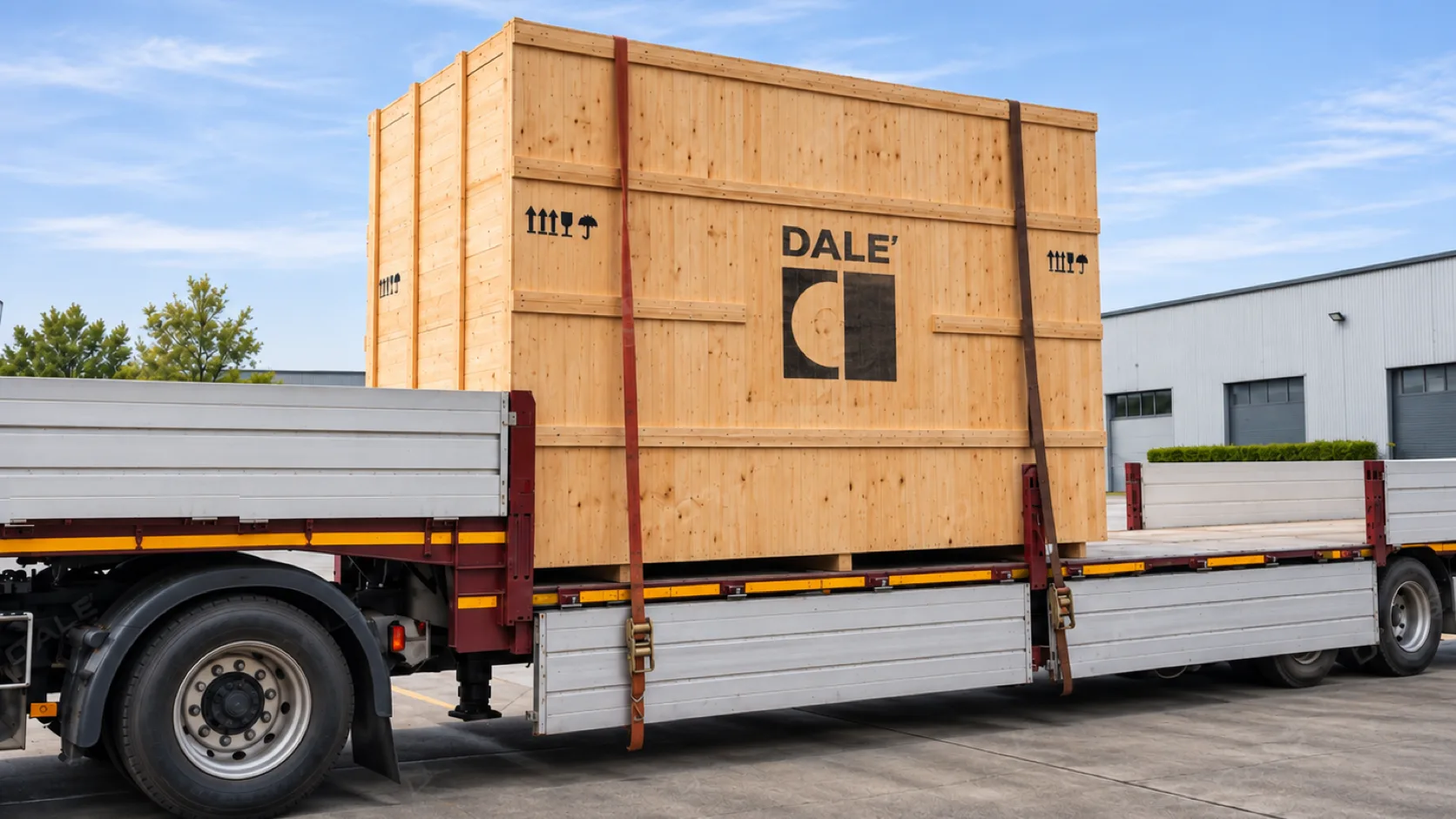
Oversized transport of works of art. When the work is bigger than the truck.
Monumental sculptures, installations and large works that exceed the dimensions of normal transport. We build the crate, apply for the permits, plan the route and follow the work until it is in place.
Answers to the most common questions.
When does a work of art need oversized transport?
When, once packed and loaded, it exceeds the dimensions or weight allowed on the road: in Italy, as a general rule, 2.55 metres in width and 4 metres in height from the ground. We check this with the dimensions of the work and the crate before choosing the vehicle.
Do you build the crate for a large work yourselves?
Yes. We build wooden crates in-house, in Brescia, to the dimensions of the work, with a load-bearing base, internal anchor points and lifting points. For shipments abroad the timber meets the ISPM 15 standard.
Who applies for the oversized transport permits?
We do, with the authorities that own or manage the roads, after studying the route. For journeys abroad a permit is needed for each country crossed.
Do you also handle unloading and placement of the work?
Yes. We survey the place of arrival and agree lifting equipment, access and times with whoever receives the work. If the final installation is someone else's job, we deliver the crate to the agreed point.
Can an oversized work travel by sea or by air?
Yes. By sea it travels on a flat rack, an open top or as break bulk cargo. By air it depends on the limits of the aircraft: as IATA agents we check them against the dimensions and weight of the crate.
Page updated:
How do you transport an oversized work of art?
When a work of art becomes an oversized load
A work of art becomes an oversized load when, once packed, it exceeds the dimensions or weight allowed on the road: in Italy, as a general rule, 2.55 metres in width and 4 metres in height from the ground, vehicle included. This happens with monumental sculptures, installations, large paintings that cannot be taken off their stretcher, and works in metal or stone. Dalè is an international freight forwarder based in Brescia, in business since 1956, which has packed and transported works of art and arranged oversized transport for many years. Here the two jobs become one.
First we check whether the work can be divided
A permit for oversized transport covers indivisible loads. So the first question is whether the work can be dismantled without damaging it: many installations are made in several elements, and some sculptures have bases or parts that separate. That decision belongs to the artist, the owner or the conservator, not to us. If the work stays in one piece, oversized transport is the right route. If it is divided, each part travels in its own numbered crate, with the instructions for reassembly.
The made-to-measure crate for a large work
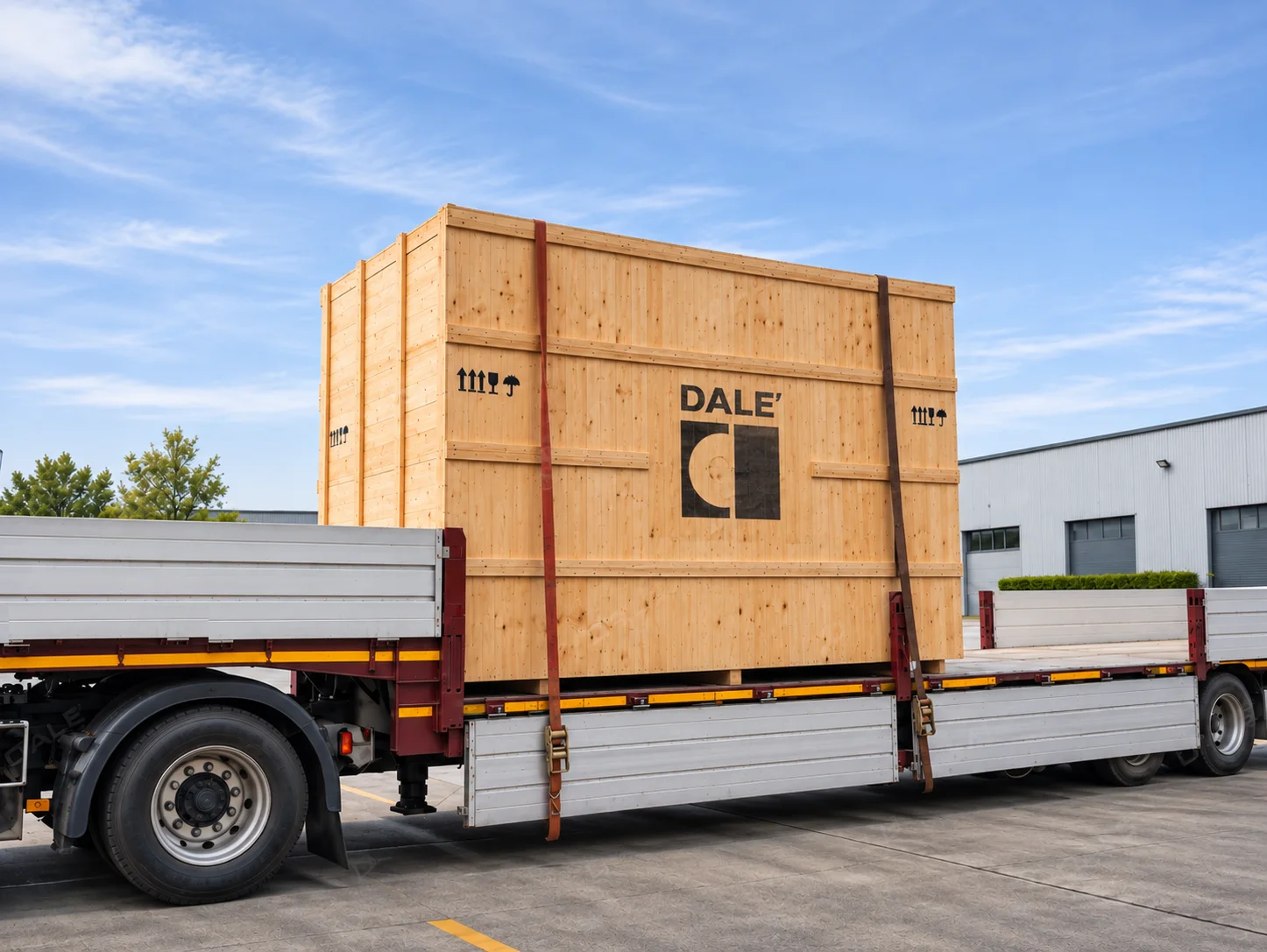
We build wooden crates in-house, in Brescia, to the dimensions of each piece. For a large work the crate is a structure: it has a load-bearing base that takes the weight, internal anchor points where the work is solid and clear space around slender parts. On the outside it carries the handling symbols, the centre of gravity and the points where the crane hooks on or the forks go in. For shipments abroad the timber meets the ISPM 15 standard. Sometimes it is the crate itself that takes the load over the limits: we work that out before building it.
Permits and route
The permit is issued by the authorities that own or manage the roads used and may set the itinerary, the days and hours of transit and a technical escort. The route is studied before the application: bridges with weight limits, underpasses, tunnels, roundabouts and tight bends. For a work of art we also look at the road surface, because vibration and jolts matter as much as dimensions. Abroad, a permit is needed for each country crossed: this is why planning starts well ahead of the date of the exhibition or delivery.
Loading, lashing and the journey
The vehicle is chosen according to dimensions and weight: a low-loader when height is the problem, an extendable trailer when it is length. Lifting is done with a suitable crane or forklift, using only the points provided on the crate. On the trailer the crate is held by straps and protected at the edges; where needed it is covered against rain and sun. During the journey the work does not change vehicle and is not unloaded at intermediate stops.
The last stretch: unloading and placement
The hardest part is often the last few metres: a courtyard, a doorway, an upper-floor room, a park with no paved road. This is why we also survey the place of arrival and agree lifting equipment, access and times with whoever receives the work. The crate is opened on site and the work is taken to where it has to stand. If the final installation is someone else's job, we deliver the crate to the agreed point.
Exhibitions abroad, sea and air
We also ship large-volume works and crates by sea and by air, and arrange oversized transport of works of art with a sea leg. For overseas destinations an oversized work travels by sea on a flat rack or open top, or as break bulk cargo when it fits no container. For air freight, as IATA agents, we check dimensions and weight against the limits of the aircraft. Our in-house customs department handles permanent or temporary export and, for exhibitions, the ATA carnet in the countries that accept it. For items that require them, export authorisations for cultural goods are also needed: we tell you who to apply to.
Insurance on the value of the work
The carrier's liability is limited by law and does not match the value of a work of art. For this reason we offer insurance cover on the declared value, valid from collection to placement. Before the crate is closed we photograph the work and record its condition together with you; the same check is repeated when it is opened at destination.
What we need for a quotation
We need the dimensions, weight and material of the work, a few photographs, the value to declare, the collection and delivery places with their access conditions, and the date by which the work must be on site. Tell us also whether the work can be divided, whether packing already exists and whether it has to come back after the exhibition. With this information we arrange the survey and propose crate, vehicle, route and documents.

