Fine art transport for exhibitions and fairs. Outbound, delivery and return in a single plan.
An exhibition or a fair has a calendar that does not move. We plan the journey of the works around those dates: outbound trip, delivery on the set-up days and return once the event is over.
Which document mistakes stop goods?
Incomplete documents, or documents that do not match
An invoice missing the required details, a packing list that does not match the packages, a consignee written in two different ways: these are the most common causes of a customs hold. That is why we ask for the documents before departure and compare them with each other, rather than discovering the mistake at the checkpoint.
A destination never verified
We sometimes receive delivery addresses that nobody has checked and that, on verification, turn out to be incomplete or non-existent. The goods then stop. Before shipping we verify that the consignee and address exist and are consistent with the documents.
Answers to the most common questions.
Do you arrange both the outbound and the return trip from a fair?
Yes, we plan them together from the start. We take the works to the venue on the set-up days and collect them at closing, to bring them back to where they came from or to a new address. If a work is sold during the fair, we change the destination and deliver it directly to the buyer.
How far ahead of an exhibition should we contact you?
As soon as your participation is confirmed and you have a list of works, even a provisional one. Made-to-measure crates, documents and booking the delivery all take preparation, and for events abroad the paperwork has to be started first. With the event calendar in hand we build a plan backwards and tell you what to do and in what order.
Can several galleries share transport to the same fair?
Yes, with groupage. Works from different exhibitors travel on the same vehicle, each in its own crate and with its own documents, and the cost of the journey is shared. At the venue each item is delivered to its own stand. It works well when exhibitors set off from the same area and have set-up dates close together.
What happens to the empty crates during the exhibition?
The crates are needed again for the return journey, so they have to be kept carefully. If the venue has no room to hold them, we can take them away after delivery, look after them and bring them back on the closing days. Every crate is marked, so on the way home each work goes back into its own.
What documents are needed for a fair abroad?
It depends on the work and the country. A work shown abroad and due to come back leaves on a temporary basis, under rules that differ from those of a sale. The authorisations are described on our page about shipping works of art abroad. We help you understand which documents you need and coordinate transport and customs.
How is an artwork's journey to an exhibition organised?
It starts with the event calendar
In an ordinary shipment you choose the departure date and delivery follows. For an exhibition or a fair it is the other way round: there is a day when the work has to be on site, and everything else is worked out backwards from it. So the first thing we ask for is the event schedule, with the set-up days, opening, closing and breakdown. We build the plan on those dates: preparing the packing, collection, the journey, delivery and return.
Outbound and return: one job
Almost every work that is shown goes home again, apart from those sold during the event. Treating the outbound and return trips as one job avoids many problems: the people who brought the works already know how they are packed, where the crates are and who should receive them on the way back. If a work is sold at the fair, we change the return destination and deliver it to the buyer. You tell us what has changed and we update the plan for each individual piece.
Set-up dates
Organisers give exhibitors specific days and time slots for unloading, often with rules on access, permitted vehicles and documents to show at the gate. Arriving early may mean not being allowed to unload. Arriving late means an empty stand at the opening. We read the fair regulations or the venue's instructions with you and book delivery in the slot you have been given. The same applies at closing, when every exhibitor has to clear the space on the same days.
Groupage: several works for the same fair
When several galleries or artists take part in the same event, their works can travel together. This is groupage: each piece stays in its own crate, with its own label and its own documents, but the vehicle is shared and the cost of the journey is split among those taking part. The same approach suits a gallery bringing many works by different artists. We prepare a list piece by piece, so that at loading and unloading we can check that every item reaches the right stand.
When dedicated transport is the better choice
Groupage is not always the answer. If the work is large, very fragile or of high value, or if the delivery slot is tight, a reserved vehicle is the sensible option: it leaves when it suits you and goes directly to the venue. For the most delicate pieces, collection and delivery can be carried out as a white gloves service. Often the solution is a mix: dedicated transport for the main work and groupage for the others.
Crates designed for two journeys
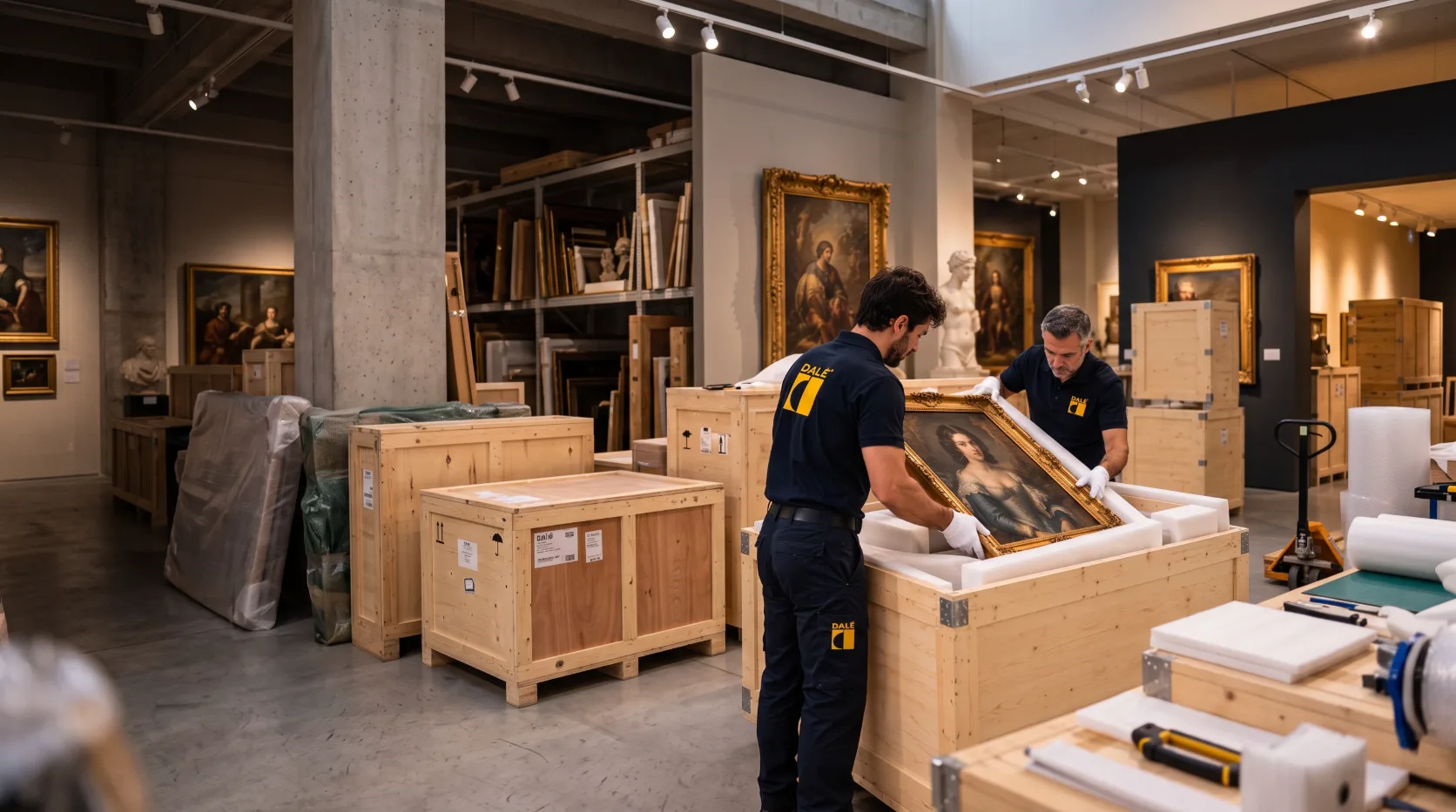
An exhibition crate has to make at least two journeys, and often more if the show tours several venues. We build it in wood to the measurements of the work, so that it can be opened and closed again without being damaged, and we mark it clearly so it can be found when it is time to go back. For events outside the European Union the wood is ISPM 15 compliant. Between venues, or while waiting for the return, the works can be held in dedicated, armoured storage.
Exhibitions and fairs abroad: temporary export
A work that goes abroad to be shown and then comes back does not follow the rules of a sale. It leaves on a temporary basis, and that calls for specific steps before departure. The authorisations required are explained on our page about shipping works of art abroad, and we do not repeat them here. Our job is to help you understand which documents apply in your case and to coordinate transport and customs. Customs formalities are handled by our in-house customs team, as an Authorised Economic Operator (AEO).
Road, air, sea and insurance
For fairs in Italy and Europe the works nearly always travel by road. For events on other continents we arrange air freight as IATA cargo agents, or sea freight when volumes are large and the calendar allows it. In every case All Risks cover on a nail-to-nail basis can be arranged. With an exhibition there is one point worth settling early: who insures the work on the days it is on show, whether you, the organiser or the transport policy itself.
Common mistakes before a fair
The most frequent is starting late: the made-to-measure crate has to be built, the documents gathered and loading slots booked. Then come wrong details: a missing hall or stand number, an exhibitor name that differs from the registered one, an on-site contact who cannot be reached. Finally, incomplete documents, which abroad stop the work before it even arrives. And one simple principle still holds: a work closed in cardboard to save time is hard to defend in front of the insurer.