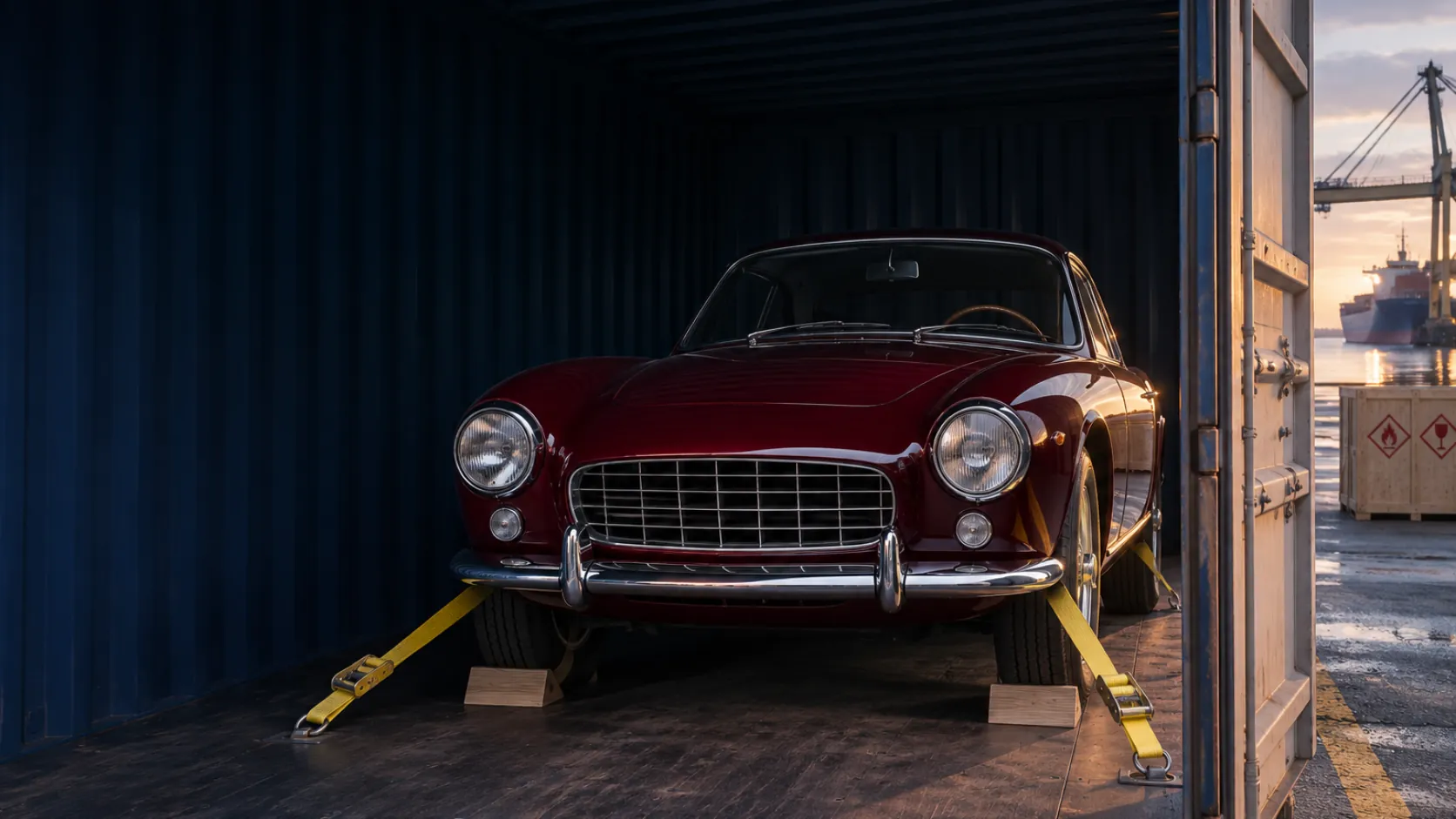
Car shipping abroad. By road, in a container or on a ro-ro vessel.
We ship cars abroad for private individuals and companies: people relocating with their own car, those who have sold it to a foreign buyer, those taking part in a rally or a race. Transport, customs and documents are handled by the same contact.
Answers to the most common questions.
Can I ship a car abroad as a private individual?
Yes, we ship cars abroad for private individuals too. You need the registration certificate, the ownership document and an identity document of the registered owner; outside the European Union we prepare the export customs declaration.
Is a container or a ro-ro vessel better?
A container gives more protection and allows several vehicles or personal effects to be loaded; a ro-ro vessel suits running vehicles and those too large for a container. The choice depends on the vehicle and on the services available at the port of arrival.
Does the car have to be deregistered to go abroad?
Yes, when the car leaves Italy for good, deregistration for export must be requested from the Italian public vehicle register. If it is leaving only for a period, for a journey or a race, temporary export is used instead.
Can I leave personal belongings inside the car?
As a rule no: on car transporters and ro-ro vessels the interior must be empty. In a container personal effects can be shipped with the car, provided they are listed in an inventory and declared to customs.
Is the car insured during transport?
Road insurance does not cover a car transported as cargo. On request we arrange All Risks cover on the declared value, from collection to delivery, and explain what it covers and what it excludes.
How do you ship a car abroad?
Who ships a car abroad
Requests come from very different situations. Some people change country for work and want to keep their car. Some sell a vehicle to a foreign buyer and need to get it there. There are dealers and traders exporting several cars, collectors sending a car to an auction or a concours, and people leaving on a long journey who want to find their own vehicle at destination. For each the documents change, not the method: first we clarify what is needed, then we book the transport.
In Europe: car transporter or enclosed lorry
Within Europe the car travels by road. The car transporter, the multi-deck vehicle carrying several cars, is the most common solution for everyday cars. The enclosed lorry protects from weather, prying eyes and stone chips, and is the choice for valuable, classic or competition cars. In both cases the vehicle is secured by its wheels and, on loading and unloading, a report on the condition of the bodywork is completed and signed by whoever hands over and whoever receives.
Overseas: container or ro-ro vessel
For other continents there are two routes. In a container the car is secured with straps and chocks inside a 20-foot unit, on its own, or in a 40-foot unit with other vehicles or personal effects: this is the most protected solution. On ro-ro vessels the vehicle drives on and off on its own wheels and travels in the ship's garages: it suits running vehicles and those that will not fit in a container. We offer both options, when the port of arrival provides them.
The vehicle's documents
You need the registration certificate, the document proving ownership and an identity document of the registered owner; if someone else is shipping, a letter of authority. For a sale, the invoice or bill of sale is also required. When the car leaves Italy for good, deregistration for export must be requested from the Italian public vehicle register. If the vehicle is subject to an administrative lien or an unpaid loan it cannot be exported: it is worth checking before fixing a date.
Customs: permanent or temporary export
Between European Union countries there is no customs, but the car must then be registered in the country of arrival under local rules. Outside the Union an export declaration is needed, which our in-house customs department lodges in Brescia. If the car is leaving only for a period, for a journey, a rally or a race, temporary export is used: many countries require the Carnet de Passages en Douane, which in Italy is issued by the Automobile Club.
Preparing the car for departure
Before handover the car should be washed, because marks can be seen and noted on clean bodywork. The tank must contain little fuel, the alarm must be switched off and personal belongings removed from the interior, unless otherwise agreed for removals in a container. For electric and hybrid cars the shipping line asks for information on the battery. Photograph the car from every side, interior included: the pictures are useful to you and to the insurer.
Transport insurance
The car's road insurance does not cover it while it is being transported as cargo, and the carrier's liability is limited by international conventions, often well below the value of the vehicle. That is why we offer All Risks cover on the declared value, valid from collection to delivery. For classic and collector cars the value is established on a documented basis, with a survey or valuation. We explain what is covered and what is excluded, and you decide.
On arrival: collection and registration
At destination the car can be collected at the port or depot or delivered to the address given. Outside the Union, the duties and taxes of the country of arrival are payable, subject to the reliefs granted to people transferring their residence. Registration with local plates remains the owner's responsibility and follows the country's rules: technical inspection, conformity, taxes. Before departure we tell you which documents you will be asked for, so you arrive prepared.