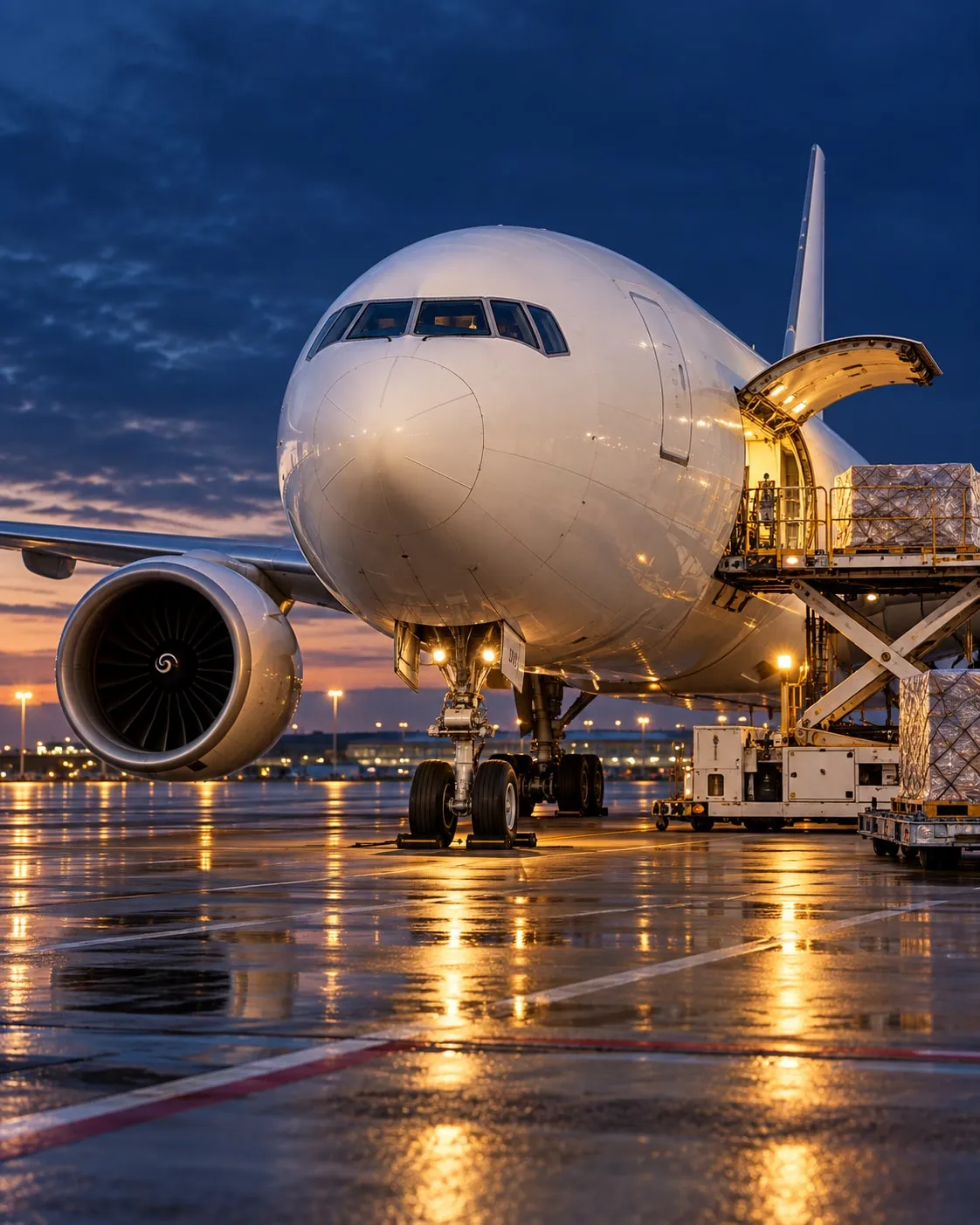
What it is and why it breaks
"Chain" means that control never stops: collection at the warehouse, transfer to the airport, acceptance, waiting, flight, transit, collection on arrival, delivery. Each step is a point where the temperature can leave the prescribed range. The most common case is an unprotected stop: a pallet standing on a sunny apron, a wait at customs, a transfer between aircraft.
Goods may require different ranges. For medicines, 2-8 °C (refrigerated) and 15-25 °C (controlled room temperature) are often used; some biological products or frozen foods need lower temperatures. The right range is set by the manufacturer, not by the freight forwarder.
How it is protected by air
In air freight, protection combines several tools:
- Passive packaging, insulating and used with coolants, which keeps the temperature for a limited time.
- Active containers, with their own power supply, for longer journeys or high-value loads.
- Cold rooms and temperature-controlled areas at airports and with handlers.
- Temperature recorders (data loggers) placed in the packages, to prove afterwards that the range was respected.
- Dry ice, which for air transport is a class 9 dangerous good (UN 1845) and must be declared and packed according to IATA rules; see dry ice.
Planning matters as much as equipment: booking flights with few stopovers, avoiding public holidays and warehouse closures, coordinating arrival at the airport with acceptance, and warning the consignee so that they are ready to collect. A good rule is never to leave the goods waiting unprotected.
Reference rules and certifications
For medicines, the European guidelines on good distribution practice apply, summarised in GDP; IATA has a certification programme for pharmaceutical cargo operators (CEIV Pharma) and publishes specific rules for perishable and temperature-controlled goods. For fresh food, see the entry on perishable goods by air, with the handling code PER. Temperature-controlled road transport is governed by the ATP agreement, see ATP.
A practical example
A pharmaceutical company in Lombardy ships a batch of 2-8 °C products to a distributor outside the EU. Collection is made with a refrigerated vehicle, and the load goes in insulated packaging with data loggers. At the airport the goods go into a cold room until loading, travel on the flight with a temperature-controlled indication, and at destination a local agent collects them immediately to deliver them to the customer's warehouse. Customs is prepared in advance so that there are no waits. Dalè plans the shipment with the airline and with equipped operators, but does not have cold rooms of its own: the choices are made on the carrier and the flight, not on the warehouse.
Common mistakes
- Not stating the temperature range and the maximum time allowed out of control.
- Using packaging not qualified for the length of the journey.
- Ignoring delays and stopovers when choosing the flight.
- Forgetting customs documents, which hold the package in a non-refrigerated area.
Sources
A shipment to organise?
Tell us what you are shipping and where to: we reply with the route, the documents required and a quote.
Related Dalè services
Related glossary terms

